Kernel for SQL Database Recovery Tool
 (4.9/5) 508 Reviews
Recover data from corrupted, inaccessible, or severely damaged MDF and NDF files and restore it to a live SQL Server. The tool helps SQL administrators and database professionals to scan and recover damaged SQL Server databases.
Download the free demo to scan the database and preview all recoverable objects.
- Recovers data from corrupted, inaccessible, and suspect MDF files.
- Recovers tables, triggers, rules, functions, stored procedures, primary keys, and foreign keys.
- Restores deleted records and recovers data from dropped or truncated tables.
- Exports recovered data to a live SQL Server or SQL scripts.
- Offer Advanced Recovery Mode to recover severely corrupted databases.
- Creates SQL script backups of recovered database data.
- Scans and previews MDF files without a live SQL Server connection.
- Automatically detects the SQL Server version.
- Supports SQL Server 2025, 2022, 2019, 2017, 2016, 2014, 2012, 2008 R2, 2005, and 2000.


- 4.9/5 Trustpilot Rating
- Safe & Secure
- 2M+ Happy Customers
- Money-Back Guarantee
- Lifetime Free Support
When Do You Need SQL Database Recovery Tool?
Check out the common scenarios where the SQL database recovery tool helps you easily restore your Microsoft SQL Server database.

Recover Database in Recovery Pending Mode
Recover SQL Server databases stuck in Recovery Pending mode due to missing, damaged, or inaccessible MDF files.

MDF File Won’t Open or Attach
Extract database objects when you cannot open MDF file or attach it to Microsoft SQL Server. Read More

Tables or Records Are Accidentally Deleted
Recover deleted records, dropped tables, or truncated data when the original data is still recoverable. Read More

SQL Server Database Stuck in Suspect mode
Recover database objects when SQL Server marks the database as suspect and prevents access to its data. Read More

DBCC CHECKDB Cannot Repair the Database
Scan, preview, and recover database objects when the native SQL database repair method fails. Read More

SQL Server Page Checksum Error
Recover database objects affected by checksum errors caused by physical or logical corruption in the database file.
Kernel SQL Recovery Tool - How It Works
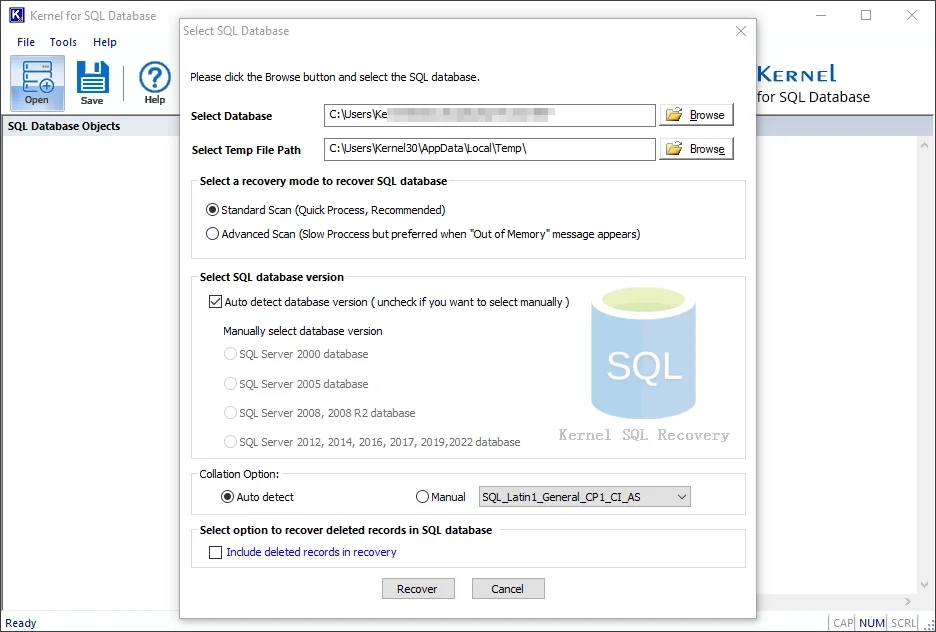
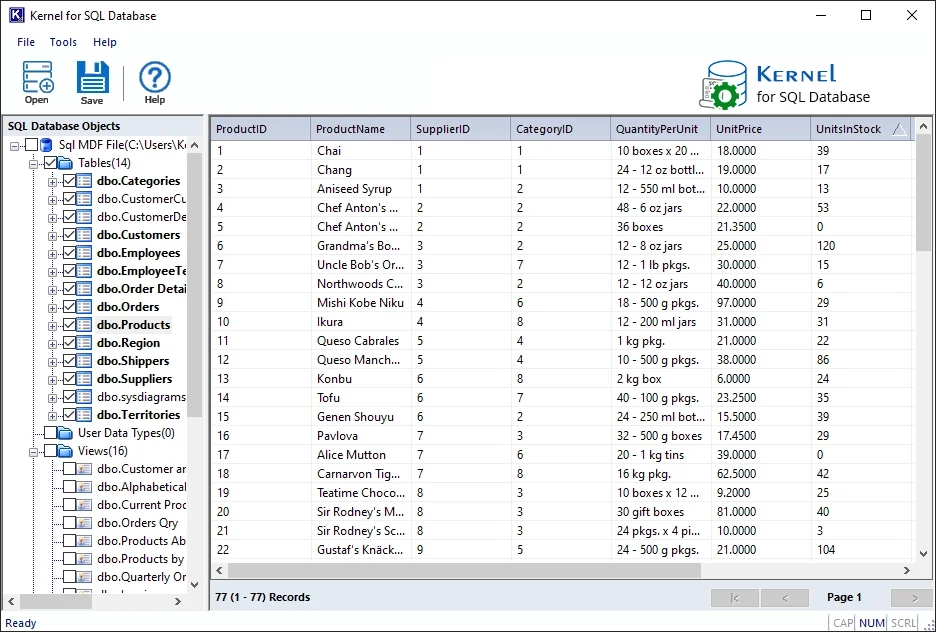
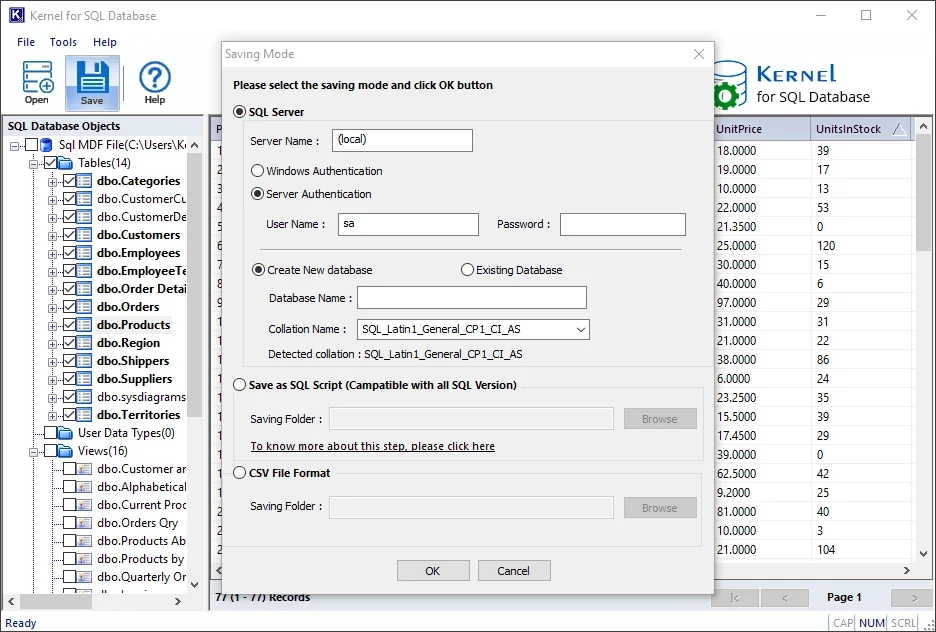
Follow the steps below to restore SQL database files using Kernel for SQL Database Recovery:
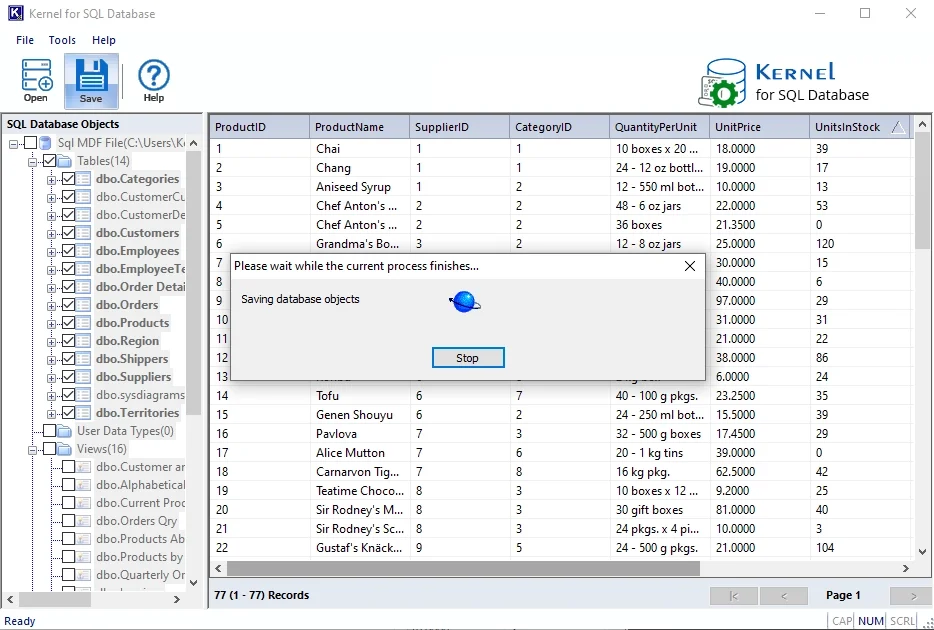
SQL Recovery Software: Key Features and Capabilities
Kernel for SQL database recovery tool offers multiple features designed to restore SQL database efficiently.

Recover SQL Database Objects
Recover SQL database objects, including tables, views, triggers, primary keys, stored procedures, indexes, unique keys, foreign keys, default values, checks, rules, and other object types while preserving their structure and properties.

Recover Deleted and Dropped Data
Kernel SQL recovery tool restores deleted records, dropped tables, and truncated table data when the affected information remains recoverable. Recovery results depend on the extent of corruption and whether the deleted data has been overwritten.

Preserve Data Integrity Post-Recovery
The SQL database recovery tool preserves the integrity of database objects after successful recovery. It does not modify table records or schema attributes. It restores views, triggers, indexes, and stored procedures in their original hierarchy.

Recover Corrupt MDF Files
The tool recovers data from severely corrupted MDF files. It repairs SQL Server databases affected by MDF header corruption, page-level corruption, and other system-level damage.

Restore Primary and Foreign Keys
The SQL Server recovery tool restores primary and foreign keys to new and existing databases. Its advanced algorithms preserve Unicode characters in keys and maintain the original table relationships.

Recover Files from BLOB Columns
Recover binary data stored in SQL Server table columns, including documents, images, and other large binary objects. The Advanced SQL recovery tool scans the database and recovers BLOB data from SQL Server tables.

Export Schema and Data to SQL Server
The SQL Server database recovery tool recovers database schemas and their data. It also lets you export the schema and data of selected tables to Microsoft SQL Server.

Fix Multiple SQL Server Database Issues
The SQL database recovery tool helps resolve various database issues, including database corruption, Suspect Mode, recovery pending errors, corrupt MDF headers, accidentally deleted SQL records, failed DBCC CHECKDB recovery, SQL Server error 5171, and more.

Save Recovered MDF Files to a Live SQL Server Database
The software allows users to recover SQL database objects and save them directly to a live SQL Server database. Users can choose to export the data to an existing database or create a new database to store the data.

Recover and Save Specific Data
The software displays an organized preview of recoverable objects. It allows users to select and save specific database objects when complete MDF or NDF recovery is not required.

Save Recovered Data as SQL Scripts
The SQL data recovery utility lets you save recovered database objects locally as SQL script files when direct export to SQL Server is not required. Users can restore the data later to live SQL Server instances by executing these SQL scripts.

Auto-Detect SQL Version and Collation
The software scans the database header and automatically identifies the SQL Server version and collation type of the MDF database file. Additionally, if required, the user can manually choose the appropriate version & collation of the database as per need.

Export Selected Tables to CSV
Kernel for SQL Database Recovery software allows you to select SQL tables and export the complete data to a CSV file. The CSV output retains table rows, columns, and recoverable values, but does not include SQL Server-specific elements such as indexes, keys, relationships, or triggers.

Preview Recovered Database Objects
Get a detailed view of the recoverable tables, records, views, stored procedures, triggers, and other supported objects before saving. The SQL recovery tool displays up to 1,000 records per page, allowing users to select any table and examine its records.

Unicode and Non-Unicode Recovery
The SQL Server recovery tool allows recovery of multilingual text and special characters in both Unicode and non-Unicode formats. It preserves text values during MDF file recovery.
What Customers Say
 Sandesh Segu, IN
Microsoft SQL database corruption can cause a lot of troubles due to the criticality of data present in database. Many SQL Server recovery tools are available that you can try to understand the features, and working.
David Clark, US
While moving my old database to a USB, the MDF file got corrupted due to a power failure. Kernel for SQL database recovery tool recovered all my tables with all the rows and columns intact.
 Sarah Muller, US
I am a database administrator, and I needed a reliable tool that could handle small as well as massive corrupted databases. I tried this tool to repair a 650 GB database. The tool recovered all 100+ tables while preserving all the data types.
Mike Willey, AU
After failing to fix header corruption in my MDF file with DBCC CHECKDB, I tried the Kernel for SQL Database Recovery tool. This tool easily scanned the SQL file and allowed me to save the tables in my original live SQL Server database.
Lance Walter, FR
The best part for me is how good it is at recovering binary large objects while keeping the database schema intact. Using this tool, I have successfully recovered tables from more than 5 MDF files.
Common Reasons for SQL Server Database Corruption
A SQL database file can corrupt due to a number of reasons ranging from human negligence to hardware errors. The most common reasons for SQL Server database corruption are:

Memory or Cache-Related Issues
A system’s faulty RAM or storage cache can affect the data processed by SQL Server and may result in database consistency errors.

Storage Media Failure
For a SQL Server database stored locally on a Windows Server disk, bad sectors or file-system errors can make the MDF database inaccessible.

Driver, I/O, or Firmware Issues
Problems with device drivers, controllers, firmware, or disk caching can interrupt database read and write operations. Incomplete writes or stale reads may lead to database consistency errors.

Improper Handling of Database Files
Sometimes, moving, renaming, deleting, or modifying MDF, NDF, and LDF files without following the proper SQL Server procedure can make the database inaccessible or prevent it from attaching correctly.

Virus Attacks
Malware or ransomware can modify, encrypt, or delete SQL Server database files, making the database inaccessible. Antivirus software should also be configured correctly so that it does not lock active MDF, NDF, or LDF files while SQL Server is using them.

SQL Server or Third-Party Software Issues
Known SQL Server issues, outdated drivers, or incompatible third-party software may sometimes result in database consistency problems. Keeping SQL Server, device drivers, and related system components updated can help reduce this risk.

Unexpected System Shutdown
An unexpected shutdown does not always corrupt a SQL Server database because SQL Server uses the transaction log during recovery. However, corruption can occur when a power failure or system crash is combined with incomplete disk writes, faulty storage, or cache problems.
Failed Cumulative Updates
When a SQL Server cumulative update is interrupted abruptly, or a new service pack installation fails in the middle, it creates a metadata mismatch in the database. This causes database boot errors.
SQL Server Database Errors Associated with MDF Corruption
The SQL Repair tool is designed to recover data from corrupted or inaccessible MDF files affected by common file errors, like:
- <FileName>.mdf is not a primary database file. (Microsoft SQL Server, Error: 5171)
- The header for file '<FileName>.mdf' is not a valid database file header. The FILE SIZE property is incorrect. (Microsoft SQL Server, Error: 5172)
- SQL Server detected a logical consistency-based I/O error: incorrect checksum. (Microsoft SQL Server, Error: 824)
- Could not open File Control Bank (FCB) for invalid file ID <ID> in database '<DatabaseName>'. (Microsoft SQL Server, Error: 5180)
- DBCC CHECKDB reported consistency errors in the database.
- SQL Server detected a logical consistency-based I/O error: torn page. (Microsoft SQL Server, Error: 824)
- SQL Server detected a logical consistency-based I/O error: incorrect page ID. (Microsoft SQL Server, Error: 824)
- Database '<DatabaseName>' cannot be opened. It has been marked SUSPECT by recovery. (Microsoft SQL Server, Error: 926)
Frequently Asked Questions About SQL Recovery Tool
Here are some common queries related to the SQL Server recovery tool’s features, working procedure, and more.
How to recover a corrupt SQL database using the Kernel for SQL Database Recovery tool?
To recover damaged tables and other database objects from a SQL database, follow these steps:
- Step 1: Open the tool and add the corrupt MDF or NDF file.
- Step 2: Select a recovery mode: Standard or Advanced.
- Step 3: SQL Server version and collation type will be automatically detected. If not, choose them manually.
- Step 4: If you want to recover deleted records also, tick the checkbox "Include deleted records in recovery". Otherwise, skip it.
- Step 5: Click the Recover button to start scanning the database.
- Step 6: The tool will list all the recoverable objects. View and select the ones you want to recover. Then, click Save.
- Step 7: Select a saving mode: Live Server, SQL Scripts, or universal CSV file. Finally, click OK to start SQL database recovery.
Can I recover lost database objects after an SQL database corruption?
Yes, you can. SQL Recovery software allows you to restore SQL database from damaged MDF file, including deleted records, dropped tables, etc.
Does the tool require a Live SQL Server environment to recover MDF file objects?
No. You can recover corrupted MDF file without SQL Server. However, the SQL Recovery tool would require an SQL environment to save/export the recovered objects to a live SQL Server.
Does the tool need a SQL backup file or transaction logs for recovery?
No. The tool can recover SQL database without backup (.bak) file. Also, you do not need the database transactional log files (LDF) to recover corrupt MDF files.
Where to find MDF file in my system?
- Windows 11: C:\Program Files\ Microsoft SQL Server <SQL-SERVER-VERSION>\ MSSQL\DATA
- Windows Server 2022: C:\Program Files\Microsoft SQL Server\MSSQL16.MSSQLSERVER\MSSQL\DATA
After database recovery, where can I save the data?
The tool allows you to save the recovered data to a live SQL Server (new or existing database), SQL Scripts (run on any SQL Server instance), or to CSV files (only tables are saved in CSV).
I have a large database of 800 GB. Can your tool repair it?
Yes. The SQL Server repair tool supports massive-size MDF and NDF files and allows you to recover SQL database files without file size restrictions.
Can I get the deleted records back as well?
Yes, definitely. The SQL Server database recovery software integrates a separate option meant to be selected when the user wants to recover deleted records.
Please elaborate on the second saving option, i.e., SQL Script in this SQL recovery software.
The tool allows saving the recovered data into an SQL Script on your local system. You can run the scripts directly on any SQL Server instance to restore the data.
I had the SQL database files from SQL Server 2012. Can I save them in the latest SQL Server 2025?
The tool supports exporting recovered data to SQL Server 2012 through SQL Server 2025, subject to compatibility between the recovered database objects and the destination version.
How to run SQL Script in the SQL Server?
Here is the step-by-step process to run an SQL Script in the SQL Server:
- Step 1: Open the Microsoft SQL Server Management Studio (SSMS) tool.
- Step 2: Connect to your database engine.
- Step 3: Select the database where you want to run the script.
- Step 4: In the menu bar, click File > Open and select the SQL script file.
- Step 5: Click the Execute button in the menu bar to run the script.
Does the tool handle minor corruption and severely damaged MDF files differently?
Yes. The SQL recovery software provides two scanning modes, Standard and Advanced. Use the Standard mode to recover a database from minor corruption. Advanced Scan is focused on severely corrupted MDF file recovery. You can pick the mode based on how serious the corruption is.
I have a detached SQL database file, and I need to extract data from my customers' orders table. Can your tool extract specific tables?
Yes. You can add the detached MDF file and extract any specific table as per your need. You can even save the tables directly to CSV files to access them without a live SQL Server.
How can I upgrade the tool from the free evaluation version to the full version?
Follow these simple steps to upgrade your SQL recovery free evaluation version to the full version.
- In the tool, click on the Buy Online icon. Then, select and buy the required license.
- You will get activation details at the email address you provided while buying the license.
- In the tool, go to Help > Activate product and enter the activation credentials to upgrade to the full version.
What customers say about Kernel for SQL Database Recovery
 (4.9/5) 508 Reviews
I had a severely damaged MDF file and needed to restore the complete database without losing records. The Kernel for SQL Database Recovery bypassed the corruption and restored all my tables with the original schema.

SQL Recovery Software Prerequisites & recommendations
 About Software
Version: 26.0
Release Date: Dec 2008
Update Date: Sep 2026
License Type: Corporate & Technician
 Version Support
MS SQL Server: 2025, 2022, 2019, 2017, 2016, 2014, 2012, 2008 R2, 2008, 2005, 2000
 System Requirements
Hard Disk: 5 GB of disk space
Memory: 8 GB Minimum
Processor: Intel® Pentium Processor compatible (x86, x64) or equivalent
Operating System: Windows 11, 10, and earlier: Windows Server 2022, 2019, 2016 and earlier
 Installation Guide