 (4.9/5) 486 Reviews
Office 365 Backup Tool to Backup Office 365 Mailboxes Locally
The Kernel Office 365 Backup and Restore tool provides a secure and reliable way to back up complete mailboxes, including emails, contacts, calendars, and more, directly to local storage. With features such as incremental backup, and granular restore, it helps protect and recover Microsoft 365, Exchange Online, and hosted Exchange data efficiently.
- Securely back up Microsoft 365 mailboxes (Primary, Shared & Archive) to reduce the risk of business data loss.
- Export mailbox items to PST, PDF, MSG, EML, HTML, and other formats for compliance, auditing, and accessibility needs.
- Incremental backup reduces time and storage by saving only new or modified data after the initial backup.
- Granular restore enables recovery of specific emails, folders, or full mailboxes for faster incident resolution.
- Backup contacts and calendars by exporting to VCF and ICS formats.
- Point-in-time recovery allows restoration from any previous backup state to handle errors or corruption.
- AES encryption helps secure backup files, simplifies retention workflows, and supports compliance-driven data protection needs.
What's new in Kernel Office 365 Backup and Restore Pro
- Backup Office 365 mailboxes and OneDrive files and folders separately.

- Run faster multiple batch backup job processing.
- Integrated with new data filters and advanced features for quick backups.
Why is Microsoft 365 Backup Required?
Microsoft 365 backup is vital as built-in retention policies and user risks can still cause data loss. Take a look at the reasons and be proactive in your data retention approach.

Shared Responsibility Model
Microsoft manages the cloud service infrastructure and provides native protection and recovery capabilities, while organizations remain responsible for managing access, retention requirements, backup policies, and recoverability based on business and compliance needs.

Fill Retention Policy Gaps
Microsoft 365 retention policies are often rigid and complex, which can create risks of accidental or permanent data loss. Backup solutions help organizations store mailbox data for long-term access, restore deleted items even after retention expiry, and recover specific mailbox versions whenever required.

Protection Against Cyber Attacks
Separate backup copies help keep business data secure from cyber threats and ransomware attacks. Organizations can quickly restore mailbox data after disasters or security incidents. No more downtime and reduces the risk of permanent data loss.

License and Storage Management
Supports compliance and audit requirements by storing mailbox backup copies in a user-defined location for long-term access and legal needs. Backup also helps manage Office 365 storage by archiving mailbox items locally, freeing up mailbox space, and retaining former employee data even after license deactivation.
Microsoft 365 Built-in Retention and Recovery Limitations
Microsoft 365 offers native retention and recovery options, but these may not be enough for every organization’s long-term mailbox backup, offline access, audit, or migration needs.
- Exchange Online deleted item retention is commonly 14 days by default and can be extended up to 30 days, depending on admin settings
- SharePoint and OneDrive recycle bin retention can span up to 93 days.
- Recovery options may vary by workload, license, policy, and administrator configuration.
- Native recovery options may not provide a separate local or NAS-based mailbox backup in exportable formats such as PST, PDF, EML, MSG, or HTML.
- For departed users, organizations should preserve mailbox data before changing or removing licenses to avoid future access and retention issues.
- Need to pay the cost to keep the license of the departed user account to retain their data, unless it is moved.

Microsoft 365 Native Retention Vs Kernel Office 365 Backup Tool
Take a glance at the section below to identify the key reasons that make our Microsoft 365 backup solution, a suitable choice for enterprise-grade data protection.
| Differential Features | Native Retention | Kernel Office 365 Backup & Restore |
|---|---|---|
| Main objective | Data retention | Backup & restore Office 365 data securely |
| Storage path | Within the Microsoft 365 cloud | Within the user-defined location on local/ NAS storage |
| Data retention period | 30 to 93 days (based on the service) | Unlimited |
| Backup file formats | Exclusive cloud format (can't read in other environments) | Cross-platform compatibility with PST, EML, HTML, PDF, and other formats. |
| Granular restore | Limited functionality | Provide filters to perform granular data restore |
| Incremental backup | Supports automatic version history | Option to backup recently added data only |
| Backup accessibility | Requires internet connectivity | Easy accessibility without intermediate application |
| Data sovereignty | Not assured | Provide complete control over the backup copies saved to the user-defined location (local or NAS) |
Advanced Features of Our Office 365 Backup Software
Scroll through the features of the tool to check out the top capabilities for a smooth backup and restore process.

Office 365 Cloud Backup
Use the Office 365 Backup and Restore tool to back up Office 365 data, including emails, contacts, calendars, etc., from primary, shared, archive mailboxes, and public folders. Apply the centralized approach to bring all mailboxes’ data under one roof with enterprise-grade backup management.

Back up Office 365 Groups
Fetch and save data from single or multiple Office 365 Groups separately within a few clicks. Plan your own retention policy for Microsoft 365 and back up Office 365 cloud with full data integrity and cyber resilience.

Backup to Multiple Formats
Protect your Office 365 data by creating secure copies in PDF, EML, MSG, HTML, and more. Recovery after a ransomware attack or virus intrusion becomes easier with the offline stored Office 365 data backup.

Microsoft 365 to Outlook PST
Export Office 365 mailboxes to PST file to create secured copies of Office 365 mailbox data and store them in a safe location. Import the downloaded PST file to any Outlook version to access the data with ease.

Selective Office 365 Backup
Run the selective Office 365 cloud backup for enterprise data protection using the smart and advanced filters within the tool. Customize your backup with data filters, item type filters, and exclude empty folders, as per your requirements.

Restore Granular O365 data
Restore accidentally deleted data with granular control to Office 365 mailboxes (item level restore) using existing backups or archive OST/PST files. Regain access to mailbox from the backup containing email, attachments, etc.
What Data Can You Backup with the Office 365 Backup Tool
Here’s a quick look at the data elements you can backup from Microsoft Office 365.
Efficiently analyzes the mailbox and saves all data with read/unread status and other email properties.
- Inbox
- Outbox
- Archive
- Sent Items
- Deleted Items
- Drafts
- Junk Email
- Notes
Support all types of attachments sent/ received within a mailbox and in any file format, including:
- Documents (.doc, .docx)
- Text files (.txt)
- Pdf files (.pdf)
- Spreadsheet (.xls, .xlsx, .ods, etc.)
- PowerPoint presentations (.ppt)
- Images (.jpg, .jpeg, .png, .gif, etc.)
- Videos (.mp4, .mkv, .mov, etc.)
Utilize our Office 365 backup tool to export all contact fields, including:
- Full Name
- Email Address
- Phone Number
- Job Title
- Company Information
- Address
- Date of Birth and more
With the Microsoft 365 backup tool, export and create backups of all calendar entries. Backup calendar entries in their ICS format.
- Meetings
- Subject
- Appointments
- Reminders
- Events
- Locations
Backup all recordings made to the Journals to secure your essential data. Safely accesses and extracts the recording for different elements.
- Emails
- Meeting responses
- Meeting requests
- Task requests and more
Take safe and secure Office 365 data backup of all the task lists created by the users and store to offline storage.
- Task with attachments
- Start Date
- Due Date
- Subject
- Status
- Priority
- Owner
- Reminders
- Recurrence (Daily, Weekly, Monthly, Yearly)
- Categories, etc.
How to use Kernel Office 365 Backup & Restore?
Follow the step-by-step process to backup or restore the desired Office 365 tenant:
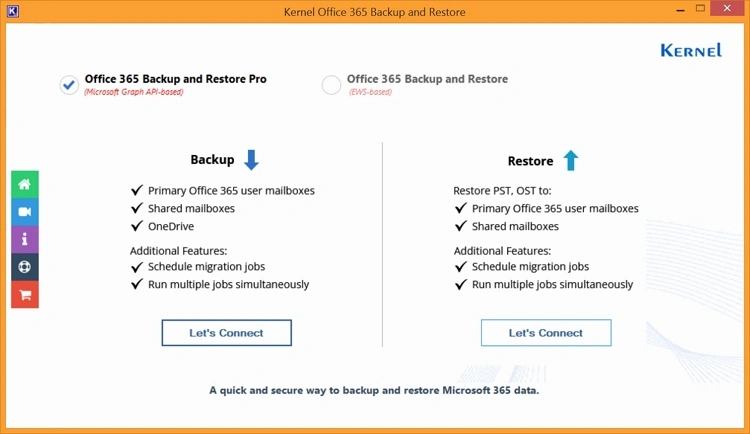
- Step 1: Launch the Office 365 backup utility and click Let’s Connect to provide source login credentials.
- Step 2: After connecting and selecting mailboxes, verify it, and start the backup process.
- Step 3: Select which mailbox to proceed with the data backup.
- Step 4: Review the folder selection and apply suitable filters to backup data.
- Step 5: Select the PST as the desired output file format in the next step.
- Step 6: Provide the file saving destination and track the real-time progress.
Why Choose Kernel Office 365 Backup Tool?
Still confused, why download this Microsoft 365 backup tool? Find out the unique functionalities of the tool that simplify your data backup and restore process.

No Outlook Installation Required
Get an easy backup and restore copy of your Microsoft 365 mailboxes in PST file, even without Outlook installation. The Office 365 mailbox backup tool comes as a standalone application but needs Outlook if you want to access the mailboxes later.

Data Portability
Unlike other Office 365 cloud backup solutions that store data within their proprietary formats, the utility saves data to PST, PDF, and other widely acceptable formats. Provides quick access to back up files even without restoration.

Prioritize Data Backup with Filters
The Office 365 backup tool allows you to selectively secure high-priority data to your system. Use data filters to exclude unwanted or junk data to protect the most sensitive enterprise assets.

Point-in-Time Restore
Accidental deletion is common and unpredictable for an enterprise. Protect your email communication history with the point-in-time restore using the isolated backup stored before losing the data.

Customer Controlled Backup Storage
Run Office 365 cloud backup tool to protect the most sensitive and crucial asset of your organization’s data. The software saves backup data to the user-defined destination and helps keep mailbox backup copies under full customer control.

Incremental Backup
Avoid backing up the entire tenant every time with incremental backups. Reduce bandwidth usage, improve efficiency and keep your business running without disruption.
Quick Checklist for Office 365 Data Backup Readiness
Answer the following pointers when planning to implement enterprise grade protection and save data with your Office 365 Email Backup tool.
- Do you have Office 365 data backup saved beyond 30 days?
- Have you saved a separate backup copy outside the Office 365 environment?
- Have you used MFA or OAuth 2.0 protection to establish backup connections?
- Can ransomware affect the saved backup?
- Do you have enough storage space on the destination to support long-term backup storage requirements?
- Can you restore individual mailbox items?
- Do you have measures to manage the large resultant PSTs to prevent file corruption?
- Have you stored the Microsoft 365 backup admin credentials in a safe location?
- Have you increased the retention period for deleted items?
- Is your Microsoft 365 backup software capable of storing backup to PST or PDF file?

Office 365 Backup Software Free vs. Licensed Version
Download Microsoft 365 Backup software to explore both free and licensed version features!
| Software Features | Trial Version |
Full Version |
|---|---|---|
| Backup Single or multiple user mailboxes | ||
| Backup shared or archive mailboxes and public folders | ||
| Use CSV to import user credentials | ||
| Backup emails, contacts, calendars, and other data | 10 items per folder | Unlimited |
| Backup data to PST, PDF, EML, MSG, etc. | 10 items per folder | Unlimited |
| Filters to backup specific data | ||
| Run incremental and scheduled backup | ||
| Supports Windows 11, Windows 10, and supported Windows Server versions | ||
| Free Download | Upgrade Now |
Microsoft Office 365 Backup Tool - FAQs
Explore the common questions asked by our users to get a better understanding of how this best Office 365 Backup tool operates.
Is there any way to backup Office 365 emails?
Yes, there are reliable ways to back up Office 365 emails for long-term protection and accessibility. Using a dedicated backup solution helps organizations create secure copies of mailbox data, automate backup schedules, and restore emails whenever required. It also helps with compliance requirements, and protection against accidental deletion and cyber threats.
Can I backup data selectively from Office 365?
Yes, with the filters available in the Office 365 mailbox backup tool, you can easily backup selective Office 365 emails. Filters in the tool include Date filters, Item Type filters, Exclude Deleted folder, Exclude Empty folders, and more.
What if I get large PST file after backing up emails from Office 365?
To avoid complications, manage the large mailbox by using the Split PST file option. It will allow you to split the mailbox into multiple small-sized PST files.
We took a thorough backup of our Office 365 tenant last month. Do we need to backup complete data again?
No, you do not need to backup entire Office 365 tenant. You can use the filter "Skip Previously backed-up Items" to make sure only recent items are saved in the new backup.
Where can I find the backup file after process completion?
After selecting the output type, Microsoft 365 backup tool asks you to provide a file saving location. Once the data backup is finished, you can find the backup file at this location.
I have a PST file containing multiple archive mailboxes. Can it be restored to Office 365 account?
Yes, simply select the desired PST file and then add the destination. Select the appropriate filters, restore the mailboxes to Microsoft tenant, and access your emails again.
How do I check the status of my Office 365 backups?
As soon as the backup process is started, the Office 365 email backup tool provides a real-time summary. It displays the items saved in backup.
Can I restore data from Microsoft 365 Backup?
Yes, you can easily restore emails, files, folders, and mailbox data from a backup using this Office 365 backup software.
How to restore a deleted mailbox in Office 365?
Admins can easily restore a deleted mailbox within a limited retention period. To restore the mailbox after the retention timeframe, use our Microsoft 365 backup tool and restore mailbox data securely.
Does Microsoft 365 provide backup?
Microsoft 365 provides native retention and recovery options, and Microsoft 365 Backup is available for supported workloads. However, users and businesses may still need separate Microsoft 365 mailbox backup copies for long-term retention, offline access, compliance, or customer-controlled storage.
How long is data retained in Office 365?
Retention varies by workload, admin settings, retention policies, hold settings, and backup configuration. Exchange Online deleted item retention is commonly 14 days by default and can be extended up to 30 days, while SharePoint and OneDrive recycle bin retention can span up to 93 days.
Can permanently deleted data be recovered?
Yes, you can recover deleted data until it is deleted completely from the Recoverable items, where they remain for 14 to 30 days. If the data is deleted from there too, you need to restore it from the existing backup saved using Office 365 backup & restore tool.
Microsoft 365 Backup and Restore Video Tutorial
Watch the video tutorial to learn how Kernel Office 365 Backup and Restore software works.


Office 365 Backup Software Prerequisites & Recommendations
 About software
Version: 26.0
Release Date: July 2026
Pricing: Ranging from $1.60 to $6 per user mailboxe
 Version support
Supports all Microsoft 365 plans, including Microsoft 365 Enterprise E1, E3, and E5, Exchange Online Plan 1 and Plan 2, Microsoft 365 Business Premium, Microsoft 365 Business Basic, Office 365 A1, A3, A5, and Office 365 F1.
System requirements
Hard Disk: Minimum 500 MB for installation and 5 GB of free space for data and log storage.
Memory (RAM): Minimum 8 GB
Processor: Intel compatible x64 processor (4 cores or higher recommended)
Operating System: Windows 11, 10, 8.1, 8, 7 and Windows Server 2025, 2022, 2019, 2016, 2012, 2008 R2, 2008.
 Installation Guide
 How to use
What customers say about Kernel Office 365 Backup Tool
 (4.9/5) 486 Reviews
I accidentally deleted all of data from my Office 365 mailboxes, which affected my everyday operations. Fortunately, I downloaded a thorough backup of the Office 365 tenant with Kernel Office 365 backup and restore tool just a couple of days back. I used the available backup and was able to restore the email communication successfully.