Read time: 6 minutes
Outlook provides an easy-to-use platform for users to efficiently send or receive emails. Business organizations prefer Outlook because of its secure network. Outlook works in both online and offline modes. When you save data in offline mode, it is saved in OST format, and the changes get automatically synced when connected to the server.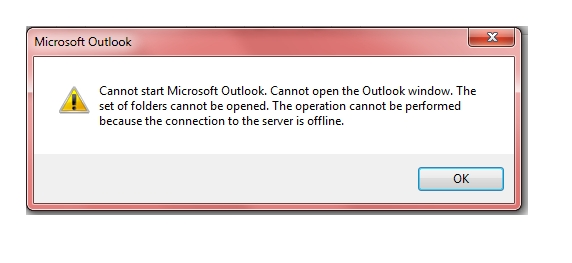
While working offline, you can face the “cannot open particular Outlook items when offline” error. It needs to be resolved immediately to avoid the long-term effects on the server and client.
What are the causes of “cannot open Outlook when offline’’ error?
When any user tries to access the OST file item in the Outlook application, suddenly an error pops up saying, “Cannot open particular Outlook items when offline.” occurs. The possible cause of this error is mentioned below:
- Incorrect configuration of settings: If the settings are not configured correctly, then it can create errors in Outlook.
- Corrupted Outlook profile: When your Outlook profile gets corrupted, it needs to be fixed immediately, as it can create issues with Outlook.
- Network issues: Poor or unstable network connection can cause errors in Outlook. Make sure you have stable and strong network connection.
Now, let’s understand the manual techniques to fix cannot open particular outlook items when offline error easily.
Methods to fix “Cannot open particular Outlook items when offline” error
There are several methods available that help you quickly resolve cannot open Outlook when offline issue. Here is the step-by-step process of each method:
Method 1: Try recreating the OST file
OST file in Outlook is a copy of Exchange Server mailboxes updated as soon as the configured server and Outlook email client are connected. So, users can always recreate OST file by deleting the original OST from the default system drive location:
drive:\Users\\AppData\Local\Microsoft\Outlook
drive:\Documents and Settings\\Local Settings\Application Data\Microsoft\Outlook
Note: Once you know the default location of OST file, you can also change the location of the OST file in Outlook.
There are two things you should do before rebuilding your OST file. First, go to the default OST file location and delete the existing OST file permanently. Then download a fresh copy of Exchange Server mailboxes with a new Exchange Server configuration with the Outlook application.
Method 2: Use ScanOST.exe tool for OST file repair
ScanOST.exe is an inbuilt Microsoft utility to fix issues in OST files and perform smooth OST file repair. Its default system drive location is Drive:\Program Files\Microsoft Office\Office_version and is available for Outlook 2007 and earlier versions only.
Find your scanost.exe utility at the following different locations for older versions, as mentioned below:
In Outlook 2003 – C:Program Files\Common Files\System\MSMAPI\scanost.exe
In Outlook 2002 – C: Program Files\Common Files\System\MAPI\scanost.exe
In Outlook 2000 – C: Program Files\Common Files\System\MAPINT\scanost.exe
So, your task is to locate Scanost and execute OST file recovery as described below.
Step 1. Close Outlook if running.
Step 2. Run the scanost.exe application on your system as an administrator.
Step 3. Select the specific Outlook profile.
Step 4. Click on the Connect option if you wish to work offline.
Step 5. Select your folder preferences as per the requirement.
Step 6. Select the checkbox saying Repair errors and click the Begin Scan.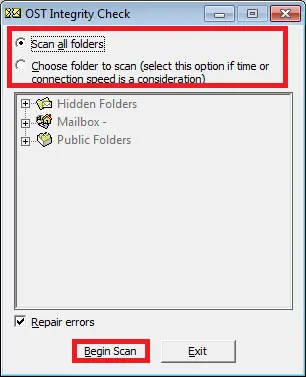
Step 7. The utility will scan all the errors and begin the repairing process.
Step 8. Wait for the process to get completed.
Step 9. Try accessing the fixed OST file now and check if you get the success.
Method 3: Try recreating Outlook profile
If recreating the OST file and ScanOST.exe fails to fix the error, there can be chances that your Outlook profile is corrupted or incorrect. So, it is advised to delete the old Outlook profile from the Control Panel Mail Setup or Account Settings in Outlook and create a profile in Outlook again. Now, try accessing OST data in Outlook and check if the error is fixed.
What are the limitations of manual methods to fix this issue?
- Not fit for repairing highly corrupted or damaged OST files.
- ScanOST.exe application use is limited to Outlook 2007 and older versions only.
- Incomplete data recovery from deeply affected OST file.
- Involved data loss threats with manual OST repair solutions.
Recover corrupt OST data with an advanced solution
To fix the severe corruption in Exchange OST files, you need a professional solution that lets you fix corruption issues in the OST file and recover desired content to a more secure file format.
Kernel for OST to PST Converter is an IT-admins recommended software to easily overcome all issues with OST files and move data to multiple accessible formats like PST or destinations like Office 365, Exchange Server, and more.
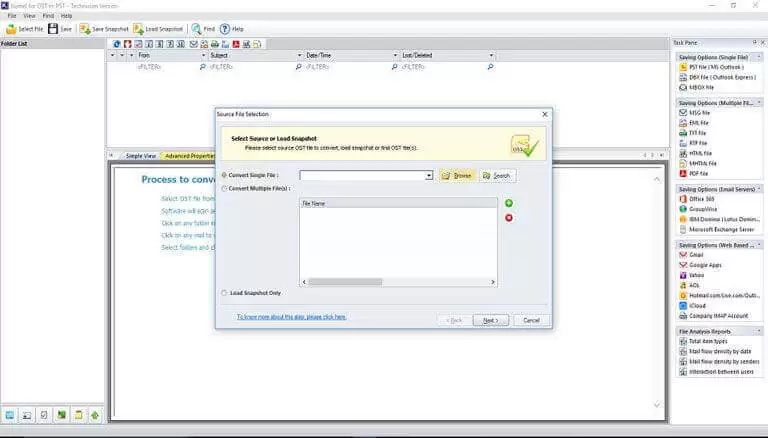
Top Features of this Advanced OST to PST Converter Tool
- Recovery inaccessible, corrupt, orphaned, or damaged OST files.
- Complete and detailed preview of recovered OST mailboxes content.
- OST recovery tool to recover permanently deleted OST file mailbox items.
- Export specific OST data to PST and file formats like MBOX, PDF, DBX, EML, MSG, etc.
- Save recovered OST content to Live Exchange, Office 365, Gmail, Outlook.com, and more destinations.
- Support for all Exchange Server and Outlook.
- A free trial version is available on the official website.
Conclusion
With the above-discussed solutions, you can easily solve Outlook errors, such as ‘Cannot open particular Outlook items when offline’. You just need to follow proper step-by-step guidance of each method to avoid such risks. Still, if you are experiencing this issue because of corrupt Outlook files, then we suggest you use the recommended OST converter tool. Download now!
Frequently Asked Questions
Ans. The error cannot open Outlook when offline is primarily seen because of:
1. Corrupt or damaged OST file.
2. OST file grows too large.
3. Profile using is damaged or corrupted.
4. Working with faulty add-ins.
Ans. Yes, due to large attachments, there can be Outlook sync failures. This is why Microsoft suggests keeping the OST file size typically under 50 GB. For that, you can split large OST files and manage them efficiently.