Read time 5 minutes
“We have been using hosted Exchange for our everyday email communication. A few months back, we planned our merger with another firm that was using hosted Exchange too, but from a different service provider. Now, we seek better email management for which we need to migrate hosted Exchange to another hosted Exchange Server. Our major concern is the data privacy and security. Please suggest if you know any such reliable solutions to make the process smooth.” – Anonymous
Many organizations migrate data from Hosted Exchange to Hosted Exchange to achieve better uptime, enhanced data security, feature upgrades, or business mergers. The migration process that often seems so simple involves a lot of groundwork and complications at the backend. However, a carefully planned strategy and a mindful execution will make the migration smooth.
How to Execute Hosted Exchange to Hosted Exchange Migration?
Any organization can face the same situation at any point in time or have other reasons to move from one hosted Exchange Server provider to another. Here, thinking of a manual solution for this highly complex migration would not be a good idea as it involves various stages like source/destination environment preparations, selection and execution of migration techniques, and performing post-migration tasks. The whole manual process is lengthy and quite complicated to perform successfully. It would take your valuable time and effort and may result in the failure of migration. So, it would be a better decision to find an alternative solution.
The main requirement here is a professional migration software that facilitates smooth hosted Exchange to hosted Exchange migration. We recommend, Kernel Migration for Exchange – Express Edition to carry out the hosted Exchange to hosted Exchange migration without any headache or data loss.
Use Kernel Migration for Exchange – Express Edition tool (for Hosted Exchange to Hosted Exchange Migration), download and install the software on your system from:
After that follow the steps one after another to perform the migration.
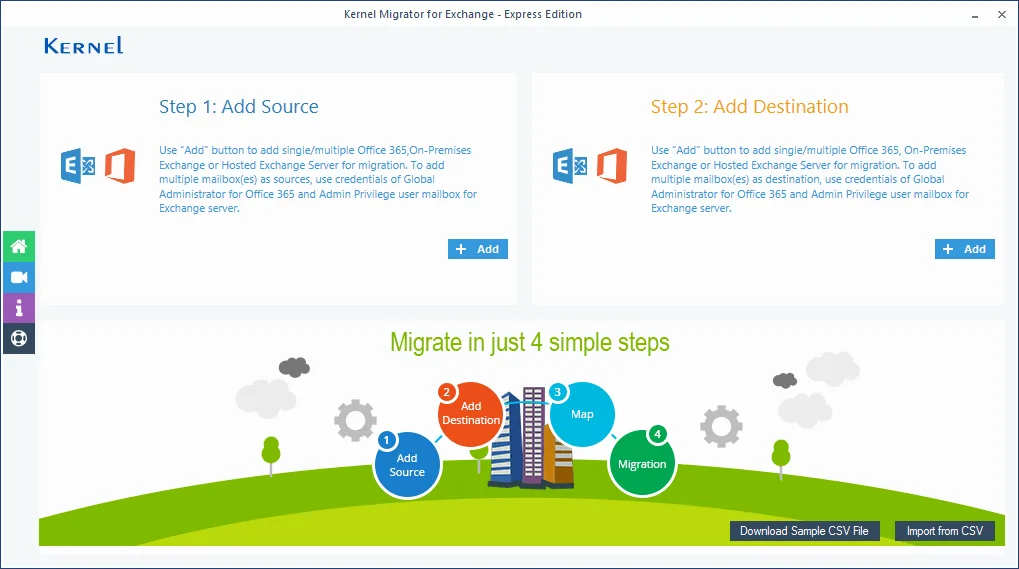
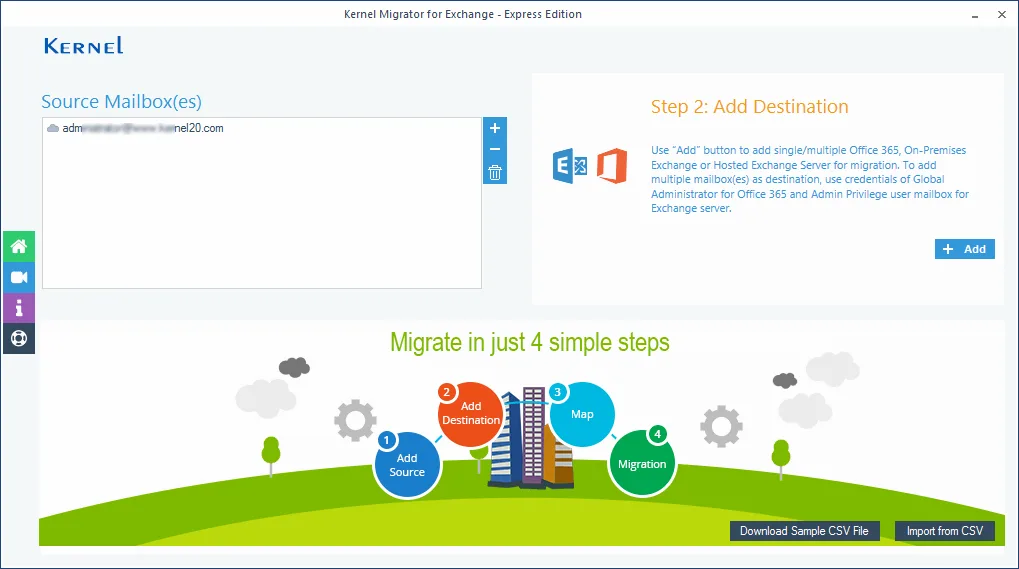
- Double-click on the software application and launch it. On the welcome screen, click Add under Add Source category to add the source hosted Exchange.
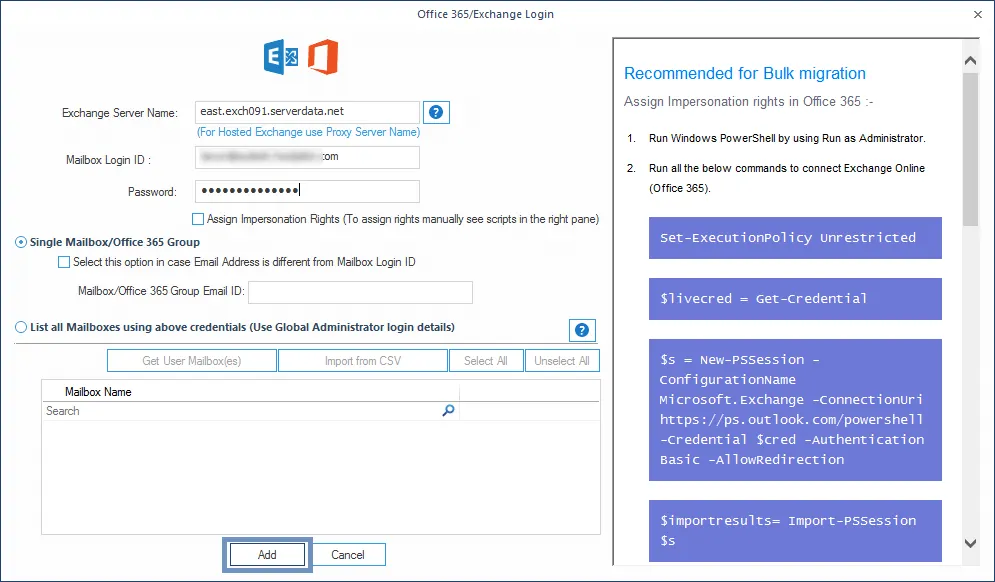
- Now provide the required login credentials for the source hosted Exchange, select the Single mailbox option, and then click Add.
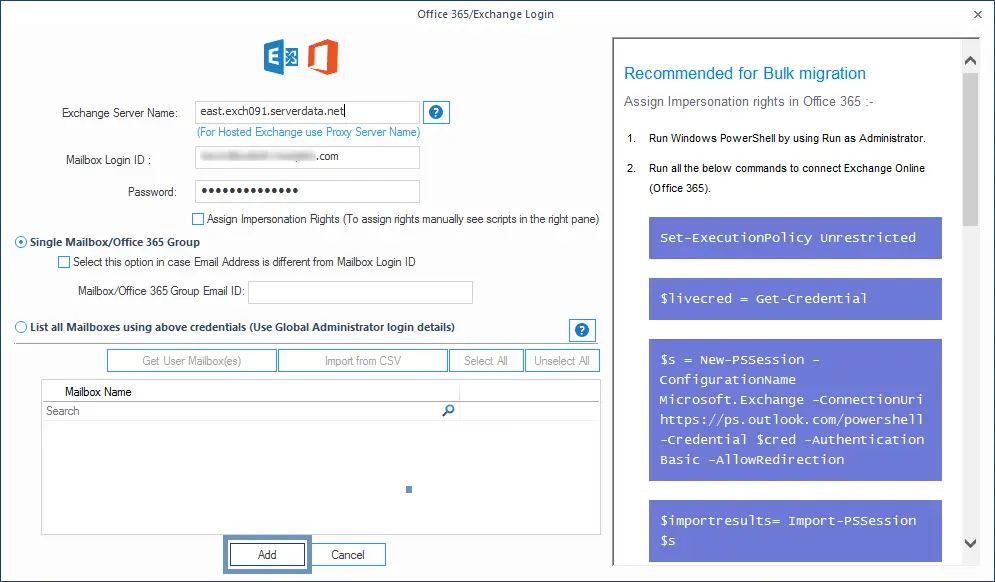 Note: For migrating multiple mailboxes from hosted Exchange, select the other option List all Mailboxes using the above credentials and click on Get User (Mailboxes) under it to list the mailboxes from the added Exchange account.
 - Now, click Add under the Add Destination section to add the destination hosted Exchange.
- Here, also enter the required credentials of the hosted Exchange account for login and click Add.
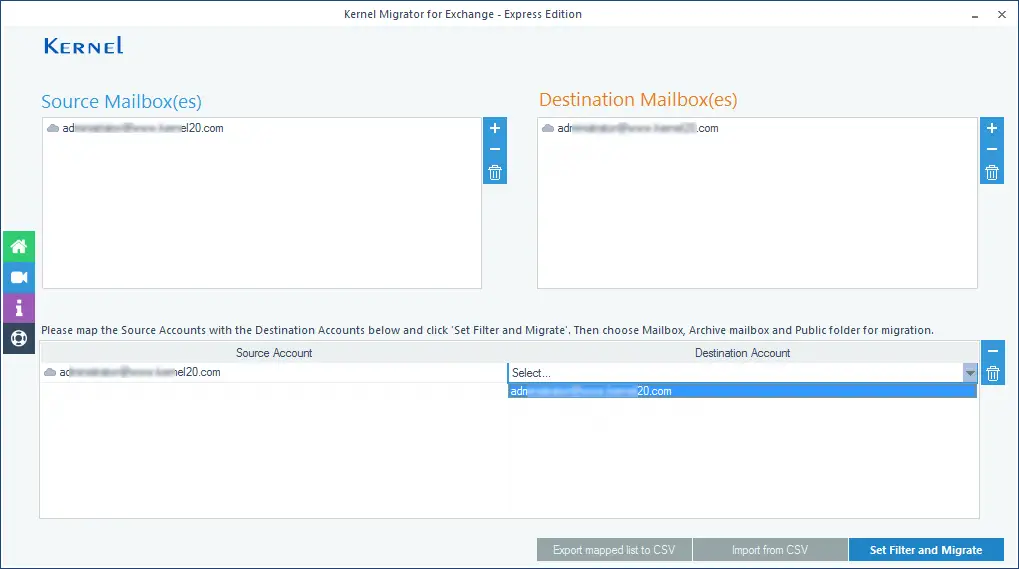
- Now, map the source mailboxes with the destination mailboxes and then click Set Filter and Migrate option.
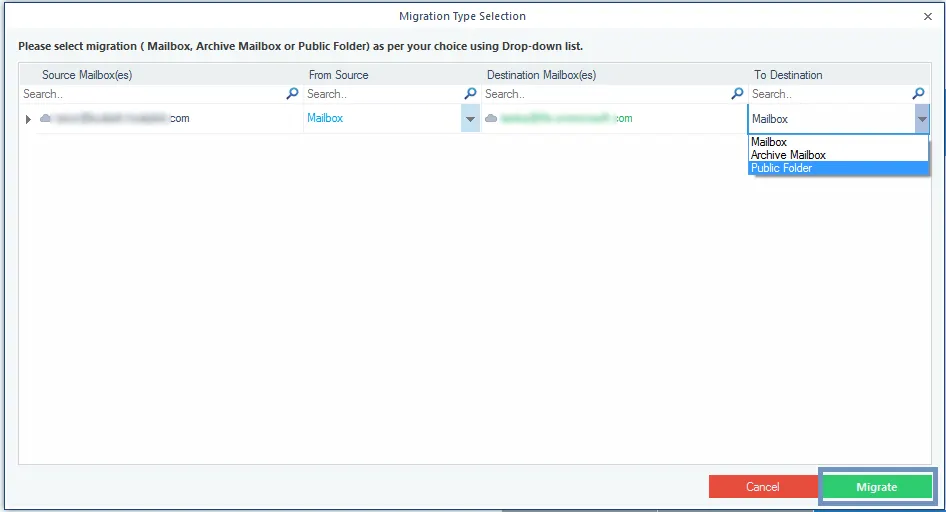
- You can select Mailbox, Archive Mailbox, or Public Folder from the source for migration. You can select the required option in the destination too. Make your choice and click Migrate.
- All the folders from the mailbox will be displayed. Select the folders, apply filters and options (if needed) and then click I am OK, Start Migration.
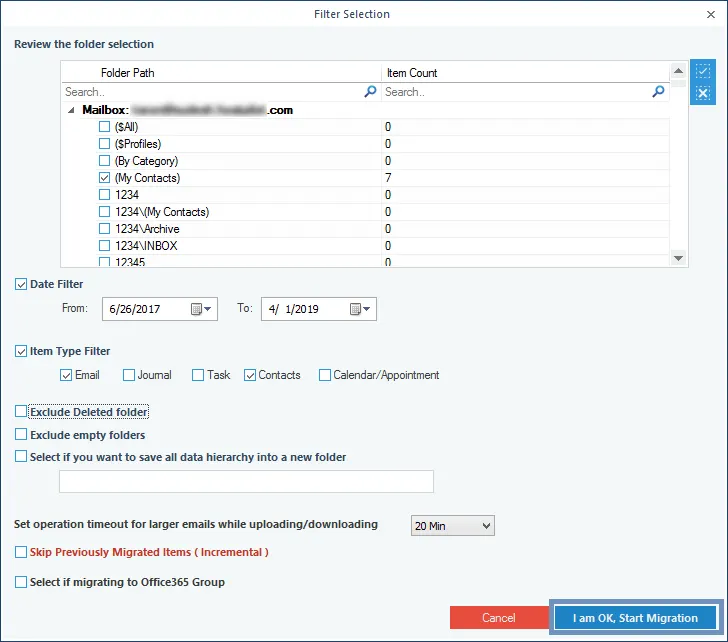
- The migration process will start. When the migration gets completed, it displays a completion message. Click OK.
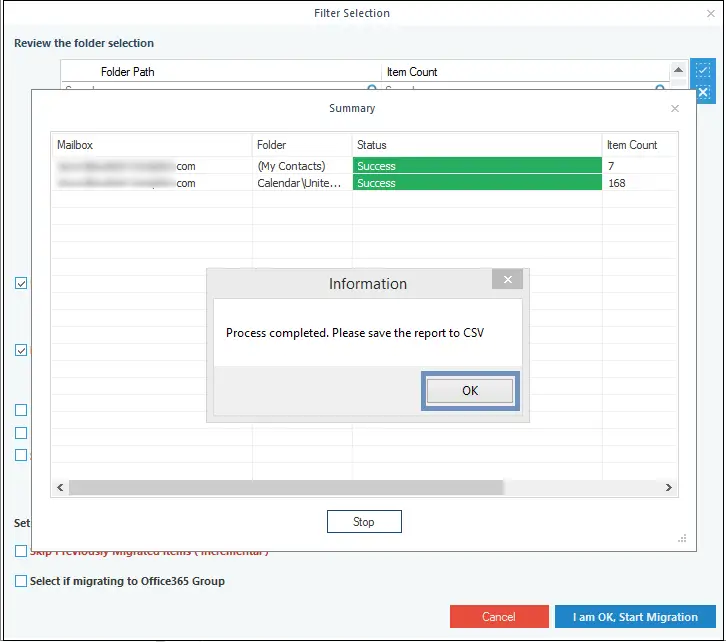 Note: You can save the migration report in CSV format by using the Save to CSV option.
Thus, a simple migration from hosted Exchange to another hosted Exchange is achieved through this migration tool.
Some remarkable capabilities of Kernel Migration for Exchange – Express Edition
- Simple and intuitive user interface
- Capable of performing On-premises Exchange to Hosted Exchange migration
- Compatibility with all Exchange Server versions
- Single/multiple mailbox migrations
- Archive mailbox & public folder migration
- Variety of filter options for selective data migration
- Folder inclusion/exclusion options
- Migrate Microsoft 365 to Exchange or Exchange to Microsoft 365
- Support for incremental migration
- Migration reports in CSV file format
- Ensures complete data security and integrity
So, this solution, with its advanced features, will help you migrate your hosted Exchange data to another hosted Exchange. It also helps you perform Exchange Server and Office 365 migrations in on-premises and cloud deployments. To take a trial, install its demo version from the website and run the tool yourself.
Conclusion
Migration between hosted Exchange environments is not just about moving emails from one point to another. It involves a systematized transition between two ecosystems with their own configurations, users, storage, and mailboxes. With a dedicated migration method, you can easily target conditional access, administrative control, and align email infrastructure. Moreover, you can skip the traditional PowerShell scripts or other native methods and use Exchange migration tool to transfer emails between hosted Exchange environments.
Frequently Asked Questions
Ans. Some of the common challenges are mentioned here:
1. Broken permissions and accesses on shared mailboxes.
2. Inconsistencies in synchronizing calendars.
3. Problems in the performance of large mailboxes.
Ans. Here is what you need to do:
1. Create Outlook profiles again
2. Re-authentication of user accounts
3. Point domain MX records to new Exchange