 (4.9/5) 452 Reviews
IMAP to Office 365 migration tool to migrate IMAP mailboxes
Migrate mailboxes from Gmail, Yahoo, Zoho Mail, GoDaddy, Amazon, and other IMAP Server accounts to Office 365 with ease. The software allows you to transfer single/multiple users' mailboxes concurrently from the same or different tenants. Run the migration task immediately or schedule it for later to minimize downtime.
Download the trial version and migrate 10 items per folder free.- Migrate IMAP mail server data to Office 365 with complete integrity.
- Bulk IMAP to Office 365 email migration through CSV authentication.
- Migrate IMAP emails and their attachments in the original hierarchy.
- Move IMAP email data to Office 365 Mailbox, Archive Mailbox, Shared Mailbox, and Public Folder.
- Advanced filters for selective IMAP to Office 365 data migration.
- Separate module to transfer IMAP data to Office 365 Groups.
- Incremental migration to transfer only newly added data.
- Generate and download a detailed migration report in a CSV file.
- Transfer IMAP emails to On-Premises Exchange or Hosted Exchange Server.
- Free trial version to migrate 10 items per folder for free.

- Added the new IMAP to Office 365 Pro module.

- Supports batch email migration from all sources.
- Schedule migration tasks to run the job automatically at a user-specific time.
- Now supports offline OST, PST, EML, and MSG files in source.
Migrate IMAP Email to Office 365 Easily in Just a Few Clicks
Go through these simple steps to migrate IMAP mailboxes to Office 365 with all emails, attachments, and folders in the original hierarchy.
IMAP to Office 365 Migration Software - Key Capabilities
Explore the major functionalities of IMAP to Microsoft 365 migration tool to execute a precise and secure migration of all IMAP server data.

IMAP mailbox migration
Migrate mailboxes of different IMAP mail servers to Microsoft 365 and Exchange Server. This IMAP Server to Office 365 utility supports all IMAP email account migrations to hosted and On-premises Exchange deployments.

Bulk mailbox migration with CSV
The IMAP emails to Office 365 Migration software offers bulk IMAP mailboxes migration using CSV authentication. Simply add bulk users in source & destination to migrate unlimited IMAP mailboxes in a single migration process.

Migrate IMAP email account to Office 365 Groups
Transfer all the IMAP emails to Microsoft Office 365 Groups. The software retrieves all the Office 365 Groups and offers a hassle-free mail migration to Office 365 Groups with all the files and folders intact.

Migrate to Archive mailbox or Public folder
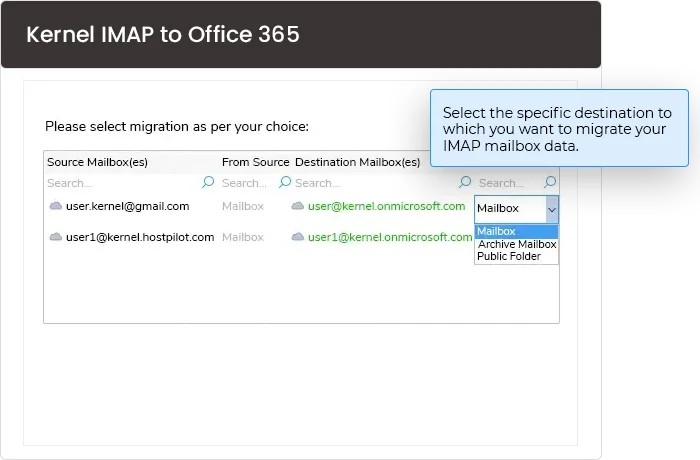
The IMAP server to Office 365 software can easily migrate IMAP server to Office 365’s Archive Mailbox and Public Folder. The software has a separate module for mailbox selection and offers an effortless IMAP email to O365 migration.

Filters for precise IMAP to Office 365 migration
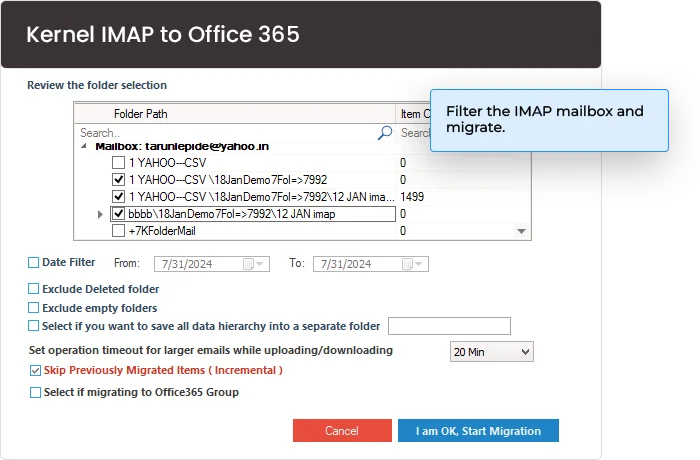
Equipped with advanced filters for selective data migration. Apply multiple filters from date range, folder type, exclude deleted folder, exclude empty folders, skip previously migrated items, and more, for precise IMAP emails to Office 365 migration.

Avoid data duplicity with incremental migration
Skip already migrated items with the incremental migration option of the IMAP to Office 365 Migrator tool. Transfer only newly added data to Microsoft Office 365 and eliminate data duplication in the destination.

Support all IMAP servers
The software supports a wide range of IMAP web-based email servers such as Gmail, Yahoo Mail, AOL.com, Outlook.com, GoDaddy, Rackspace, Lotus Notes, GroupWise, Office 365, etc.

Migrate large-sized IMAP mailboxes
The IMAP to Office 365 Migrator tool can easily migrate unlimited large-sized IMAP mailboxes with complete data integrity. There is no such file size limitation in the software. Add unlimited mailboxes and migrate IMAP Mail to Office 365 securely.

IMAP to IMAP mailbox migration
Transfer emails from one IMAP account to another using the IMAP to IMAP migration tool. Add any IMAP email client or server, such as Zoho, Yahoo, and Gmail, as a source and destination using admin credentials.

IMAP to Google Workspace migration
With our IMAP to Office 365 migration tool, you can migrate mailboxes from over 20+ IMAP servers to Google Workspace by connecting the source and destination accounts. The tool ensures effective migration while retaining the mailbox and folder hierarchy between both accounts.

Free IMAP to Office 365 Migrator
The Kernel IMAP to Office 365 tool has a free trial version. You can download and test the tool for your migration requirements for free with a few limitations. To remove the restriction, upgrade to the licensed version of the software and enjoy an unlimited IMAP to Office 365 mailbox migration.

Generate migration summary report
Track the real-time process with the migration summary report and save the migration information in a CSV file for future reference. The report includes details such as Source mailbox login ID, exported Folders, Migration Status, Item Count, etc.
IMAP to Office 365 - Where We Migrate Data?
Explore all the specific destinations where our IMAP email to O365 software migrates from the source without data loss.
| Components | |
|---|---|
| Mailbox | Move IMAP data to Office 365 mailbox effortlessly. Transfer all the IMAP data, including inbox emails, sent items, drafts, trash, spam, and other folders securely. |
| Archive Mailbox | Archive Mailbox Transfer all emails, attachments, and recipient email addresses to the Archive mailbox of Office 365. Move all the older data and manage space in Office 365. |
| Shared Mailbox | Shared Mailbox Migrate IMAP data to Office 365 shared mailbox with attributes. Access all the IMAP data in Shared Mailbox with the shared members (who have access to the mailbox) of the organization. |
| Public Folder | Move all IMAP Servers data to the public folder of Office. Check out all the IMAP emails in Public Folder where everyone can access emails with all the general information and news. |
| Office 365 Groups | Migrate 20+ IMAP Servers mailboxes to Office 365 Groups. Save all the mailboxes data to Office 365 selected Groups and share essential data with the group members. |
IMAP to Office 365 Pro: Advanced Capabilities
Extend your email migration scope with the pro version of the Kernel IMAP to Office 365 tool.

Migrate Offline Files to Office 365
The IMAP to Office 365 Pro allows you to transfer emails from OST, PST, MSG, EML to Office 365 along with IMAP migration. Every email is migrated with original metadata, and even the read/unread status is preserved.

Schedule Migration
The IMAP email to Office 365 tool Pro version offers a scheduling feature to run the migration at your specified time and date automatically, every day, week, or month. A separate report is generated for each transfer job that you can view or download.

Batch IMAP Migration
Create multiple migration jobs and run them all together. The IMAP to Microsoft 365 software pro version utilizes multi-threading for handling batch IMAP migration between different sources and destinations.

Quick Migration Configuration
The tool allows you to save your account's credentials. It helps you to instantly connect the tool to source and destination when configuring IMAP server to Office 365 migration jobs. Save login details for single/multiple accounts.

Advance Migration Controlling
The software provides in-built options to control the email transfer. Start, Pause, Refresh, or Stop any import IMAP to Office 365 or any other migration job as per your need. You can even view the live folder and item count migration during transfer.
Compare Free vs Automated Method for IMAP to Office 365 Migration
Prerequisites
Before starting the IMAP to Microsoft 365 migration, ensure the following requirements are met:
Microsoft 365 Admin Access
Use an account with the required Exchange administrator permissions.
Source IMAP Details
Keep the IMAP server address, port number, and valid source mailbox credentials ready.
Target Mailboxes
Create the destination mailboxes in Microsoft 365 and assign the required licenses.
Migration Checklist
Verify the following points before starting the migration:
Verify IMAP Access
Confirm that each source mailbox supports IMAP access and valid authentication.
Prepare Mailbox Mapping
For EAC migration, prepare a CSV file containing source email addresses, usernames, and passwords.
Check Migration Scope
Confirm mailbox access, available Microsoft 365 storage, and the total number of mailboxes.
Migrate IMAP to Microsoft 365 Mailboxes Using EAC
Follow these five steps to migrate emails from an IMAP server to Microsoft 365 through the Exchange Admin Center (EAC).
Sign in to EAC and navigate to Recipients > Migration to create a migration batch.
Select the migration option for Exchange Online, choose IMAP as the migration type, and enter the source server details.
Upload the prepared CSV file containing source email addresses, usernames, passwords, and required mailbox details.
Review the settings, assign a batch name, configure the required options, and start the migration.
Monitor the batch status, resolve errors, verify email delivery, and complete the batch after successful synchronization.
Migrate Using Outlook Application
Move messages from the IMAP mailbox to Microsoft 365 using the Outlook desktop application.
Add the IMAP account to Outlook and enter the source email address, password, and required server settings.
Allow Outlook to synchronize the IMAP mailbox. The duration depends on mailbox size and connection speed.
Set up your Microsoft 365 account in the same Outlook application using the appropriate account credentials.
Limitations of Migrating IMAP to Office 365 Using the Free Method
Although free methods can migrate IMAP emails to Office 365, they may require considerable manual effort and troubleshooting. Depending on the method and configuration, users may encounter synchronization issues, migration errors, or incomplete transfers. It does not transfer contacts, calendars, or tasks, and some mailbox metadata or properties may not be preserved. Always verify the migrated data before decommissioning the source mailbox.
How to migrate IMAP to Office 365 using a professional tool?
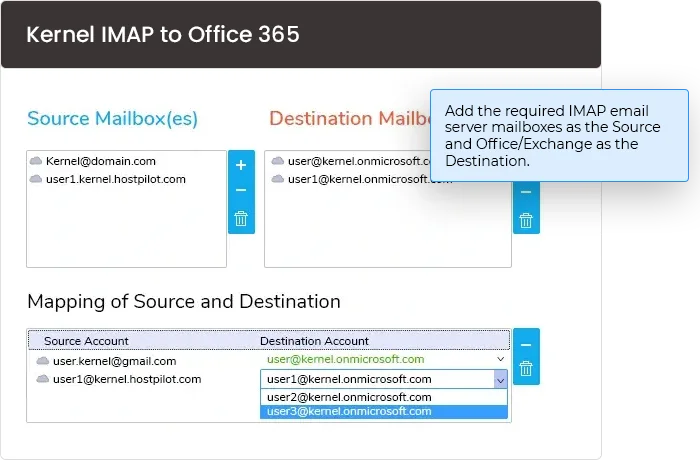
Run Kernel IMAP to Office 365 software and click on IMAP to Office 365 tile.
Add source IMAP mailbox and destination Office 365 account.
Select Single/Multiple Mailbox and map source with destination.
Select migration type - Mailbox, Archive Mailbox, and Public Folder.
Apply filters for selective data migration to destination Office 365.
Finally, click "I'm OK, Start Migration" to start the migration process.
Generate and download a detailed migration report in a CSV file.
Frequently Asked Questions - Kernel IMAP to Office 365 Migration
Does the tool support all IMAP email servers?
Yes, our IMAP email to O365 tool supports all IMAP email servers and migrate IMAP to Office 365 with ease. The tool supports all IMAP-enabled email servers like Office, Exchange (on-premises & hosted), GroupWise, Lotus Notes, Yahoo, Gmail, Outlook.com, GoDaddy, Rackspace, and others.
How can I connect with an Office 365 account using the Modern Authentication option?
When you choose the Modern Authentication, you need to enter the following details -
- Tenant ID – Tenant ID is mentioned in the Overview section of the Active Directory of your application.
- Client ID – Client ID is accessible in the overview section also.
- Client Secret Key – Client Secret Value is mentioned in the Certificates & Secrets section.
Note: You can easily create Modern Authentication credential by following the on-screen instructions.
Can I connect with multiple mailboxes by using the Modern Authentication option?
Yes, you can connect with multiple mailboxes using the Modern Authentication option. It is a secure method to connect with Office 365 using credentials like Client ID, Tenant ID, and Client Secret Key. With these credentials, the software retrieves all the users from the Office 365 account and lists them. After that, you can easily process bulk import IMAP emails to Office 365.
What are the limitations of the free version of the tool?
The free version of the software has different limitations, depending on the migration type and version.
Standard Versions: 10 items per folder
Pro Version:
- For online-to-online migration: 100 items per folder
- For offline to online migration: 50 items/folder for OST & PST and 50 files/migration for EML and MSG.
While performing migration, can we avoid deleted or empty folders?
IMAP to Office 365 software provides two filter options - Exclude Deleted folder and Exclude empty folders to avoid deleted or empty folders migration.
How can I perform multiple mailboxes migration using this tool?
The IMAP to Office 365 Migrator software offers a CSV authentication feature. With this feature, you can easily add a CSV file containing mapped IMAP and Office 365 users to migrate unlimited mailboxes at once.
Can the tool migrate offline email files?
Yes, the IMAP to Office 365 Migration Pro versions allow you to add and migrate multiple email files, such as OST, PST, EML, and MSG. The tool can migrate emails from offline files directly to Office 365 or any IMAP server.
How can I use CSV files for multiple mailbox migration?
The CSV file makes it easier to migrate multiple mailboxes at once. Just follow the given steps:
- Step 1: Launch the IMAP email to O365 tool.
- Step 2: Click on Download Sample CSV File option on the software’s home screen.
- Step 3: Open the CSV file on your system and enter the necessary credentials in it.
- Step 4: Now, click Import from CSV file on the software’s homepage.
- Step 5: In the following window, select the CSV file.
- Step 6: The software will automatically add those mapped users.
- Step 7: Now, you can easily initiate IMAP to Office 365 migration.
Thus, the complex migration of multiple mailboxes gets easier with CSV files.
How can I know if my Gmail account is IMAP-enabled or not?
To know if your Gmail account is IMAP enabled or not, try these steps:
- Step 1: Login to your Gmail account with your User ID and password details.
- Step 2: Click the gear-shaped icon Settings on the right-most side of the main screen.
- Step 3: Select the tab Forwarding and POP/IMAP.
- Step 4: If you scroll down the list, you will find the IMAP Access option. Click it.
- Step 5: Check Status: It could be IMAP is enabled or disabled.
- Step 6: Choose your priority by clicking on Enable IMAP or Disable IMAP options.
- Step 7: If IMAP is enabled, you can easily migrate IMAP Server Gmail to Office 365 within 3-4 steps.
After the expiration of the Client Secret, can I create a different one?
Yes, you can create a new client secret to access the Office 365 mailbox.
Can this tool migrate both Gmail and Outlook.com email servers (IMAP enabled) to Office 365 simultaneously?
The IMAP to Office 365 tool can migrate multiple IMAP mailboxes to Office 365 simultaneously. It also allows users to migrate different IMAP email servers to Office and Exchange destinations.
For example - If you want to save your Gmail account and Outlook.com account mailboxes to the cloud, you can add them with credentials or use a CSV file for direct addition for migration. Similarly, you can migrate as many different IMAP email servers; all you need are the login details of respective email servers and the destination.
What is the difference between IMAP and POP3 protocols?
- With IMAP configuration in the email server, you can simultaneously access your email from several devices. With the POP3 protocol, you can access mail on a single device.
- IMAP configuration requires an internet connection to access emails, whereas there is no need for internet connectivity for POP3 protocols (but required for sending and receiving emails).
- IMAP provides a faster overview of emails (only headers are downloaded) as compared to POP3-configured emails.
- IMAP relates to two-way communication, while POP3 provides one-way communication for email servers.
What are the details regarding the refund policy of the tool?
The IMAP to Office 365 migration tool provides users with a Free Trial before purchasing, where you can go through a general overview of all the smart features, along with some data migration (10 items per folder). Once the user is satisfied with all the running features of the tool, they can buy the tool as per their wish for unlimited, swift migration. Considering the tool's reliable and secure programming, there are very few chances of migration errors.
Once the users are satisfied with all the running features of the tool, they can buy the tool as per their wish for unlimited, swift migration.
Taking tool’s reliable and secured programming into consideration, there are very less chances of errors in migration. However, users can ask for any issue to our support team, which is available 24*7 hours. The support team may ask for the file in which the issue is being faced.
Our company will integrate a refund policy on this software purchase if the issue persists. The users can avail of a full refund for the purchased tool, if they face issues in migration and disruption in function even after taking help from support. For a refund, write a mail to sales@nucleustechnologies.com regarding the refund of the tool, mentioning the issue in detail.
Note: Cases in which no refund or partial refund is available
- Case 1 - The user denies sending the file with the issue for inspection even after signing the NDA (Non-Disclosure Agreement) as the issue remains hidden.
- Case 2 - The user has purchased the tool but does not want to use it in the future.
- Case 3 - Without trying the Demo version, the user has found that his system OS is incompatible with the software.
- Case 4 - A partial refund facility is available if a different tool has been bought than the required one.
I have been trying hard to migrate my 50 mailboxes to Office 365 for the last two days. I tried synchronizing IMAP folders manually, then converted them into PST format. Importing the PST files to Office was easier, but during this whole migration, some important data was lost. I got frustrated with this tiring method. Please suggest a quicker and more affordable solution.
Synchronizing IMAP folders manually will take a lot of time and include the risk of data loss. The method you mentioned becomes lengthy as you need to convert IMAP mailbox data to PST and then import IMAP to Office 365.
When you try to migrate emails directly from IMAP to Office 365, there are chances of errors in creating a new Outlook profile for each user.
So, an easier way to migrate IMAP to Office 365 is using an affordable IMAP to Office 365 tool. You just need the login details, server name, and port number to migrate your IMAP mailboxes. The migration is performed in just a few steps. The software costs less than other migration tools and performs with full efficiency.
As most of them are, our organization is also going for cloud migration. Email client AOL.com includes some vital data in IMAP folders. So, please provide me with an instant solution for retrieving IMAP data in the Office 365 location.
Accessing your IMAP data easily at a new location with the IMAP to Office 365 migration tool is possible. Download the tool; enter the login details, server name and port number, and return your IMAP mailbox data. The migration tool provides an easy approach to migrating only required data with advanced filters. You can save this retrieved data to Office 365 and Exchange Server.
Can I migrate selective folders from the inbox IMAP to the Office 365 account?
Yes, surely. The software can easily migrate selective folders from inbox IMAP to the Office 365 account.
Can I migrate an IMAP Server Gmail label to a folder in Office 365?
The IMAP data to Office 365 migration software can easily backup an IMAP Server Gmail data, including labels, emails, and flags, to a specific folder in Office 365.
Can I migrate data from IMAP Server to Office 365 Groups?
Yes, you can migrate IMAP Server Gmail data, including emails, attachments, and labels, to a specific folder in Office 365 using our IMAP data to Office 365 migration software.
IMAP to Office 365 Migration Software Prerequisites & recommendations
 About Software
Version: 26.0
Release Date: July 2024
License Type: As per no. of mailboxes
 Version Support
Office 365 (Microsoft 365): All plans, including Office 365 (Microsoft 365) Enterprise E1, E3, E5 & Exchange Online Plan 1, 2, Microsoft 365 Business Premium, Office 365 A1, Office 365 A3, Office 365 A5, Office 365 F1, and Office 365 Business Essentials.
IMAP Email Server: All IMAP servers, including Gmail, Microsoft Exchange Server, Zimbra, Dovecot, Courier Mail, Outlook/Hotmail, Yahoo Mail, Proton Mail, Bluehost, GMX Mail, Yandex Mail, FastMail, Mail.ru, Apple Mail Server, iCloud Mail, AOL Mail, Cyrus IMAP, MailEnable, hMailServer, Mail-in-a-Box, Apache James, Citadel, Kolab Groupware, MDaemon Email Server, Modoboa, Zentyal, Zoho Mail, Company IMAP Account, etc.
 System Requirements
Hard Disk: 500 MB of disk space
Memory: 2 GB ( Recommended)
Processor: Intel® Pentium Processor compatible (x86, x64) or equivalent
Operating System: Windows 11, 10, 8.1, and older versions.
Windows Server 2022, 2019, 2016, 2012, 2008 R2/2008, 2003, R2/2003
 Installation guide
 How to use
What customers say about Kernel IMAP to Office 365 Migration Tool
 (4.9/5) 452 Reviews
Successfully transferring all historical data from Yahoo Mail to my new Office 365 account brings me satisfaction. I am pleased with the software's process and reassured by the fact that all my data remains secure throughout the migration.