Read time: 5 minutes
Answer: To open shared calendar in Outlook 365, login to OWA with your credentials, go to Calendar, then People’s Calendar, and your shared calendars will be listed there. If you don’t find a specific one or fail to access it, you might have insufficient permissions. To counter this, check the required permissions, accept the sharing invitation from your inbox, verify your account (personal or work), or re-add the calendar.
A shared calendar in Outlook 365 makes it easier to see another user or colleague’s availability, schedules, meetings, or coordinate work all in one place. It frees users from having to ask whether they are free or not. If someone has shared their calendar with you, you can usually add it directly to your calendar view and be part of smooth collaboration.
The process to open shared calendar in Outlook 365 is easy when you’ve been granted sufficient permissions. In this guide, we’ll explain how to view shared calendar in Outlook 365 and what you can do if the shared calendar isn’t showing.
Difference Between Shared Calendar and Shared Mailbox Calendar
You may be confused about the terminologies; shared calendar and shared mailbox calendar. Here are the differences you need to know:
| Shared Calendar | Shared Mailbox Calendar |
|---|---|
| User shares personal calendar | Organization mailbox calendar |
| Permission controlled by owner | Managed by admins |
| Doesn’t have its own email address | Has an active email address and inbox |
| Usually appears under People’s Calendars | Appears under shared mailbox |
Prerequisites to Open Shared Calendar in Outlook
So, now let’s talk about the prerequisites to open a shared calendar in Office 365. Before you try to open a shared calendar, make sure:
- You are signed into the correct Microsoft 365 account.
- The calendar owner has shared the calendar with you.
- Your organization has permitted you to view it.
- You’ve a stable internet connection.
- You have the required calendar permissions.
- Your Outlook application is updated.
In a shared calendar in Outlook 365, the available actions depend on the permissions granted by the calendar owner.
For example: You may only be able to see free/busy information with view-only permission, but with higher permissions, you can view, schedule, or edit calendar items. Microsoft also notes that opening another user’s Exchange calendar requires an Exchange account and appropriate access. Understand the different permissions and what you are allowed to do with the table:
Shared Calendar Permissions and Access Levels
| Permission | Access |
|---|---|
| Availability only | See free/busy status |
| Can view titles and locations | View meeting details |
| Editor | Create/edit meetings |
| Delegate | Manage calendar on behalf of owner |
Read More: Step-by-step guide to create a shared calendar in Office 365
Step-by-Step Process to Open Shared Calendar in Outlook for Web
The process to open shared calendar in Outlook for the Web (OWA) is simple. Here are the steps to do so:
- Log in to Outlook and select Calendar.
- Scroll down and tap on People’s Calendar.
- If you’ve access to any shared calendar, it will be added to your calendar view.
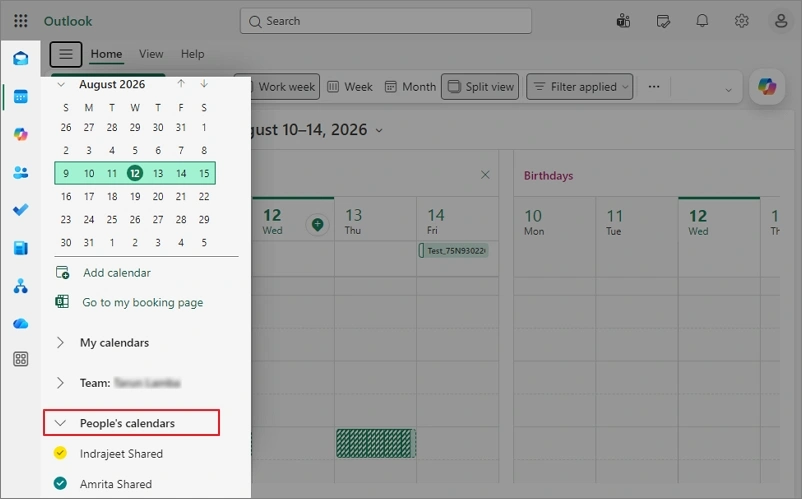
Microsoft notes that a calendar opened directly through Outlook on the web may not appear across all Outlook clients. If you want the shared calendar to be consistently available across Outlook applications, the owner should share the calendar with you directly.
Outlook Shared Calendar Not Showing? Try These Basic Fixes
If you followed the steps above but the shared calendar is missing, try the following solutions.
- Check the calendar permission and ask the calendar owner to confirm that your account has access.
- Make sure you’re using the correct account. Many times, users with multiple accounts get confused, especially when they’ve configured personal and work accounts.
- Microsoft recommends accepting the invitation to add another person’s calendar to your calendar. To do that, open the message and select Accept.
- If the calendar was previously working but has disappeared, remove it from your calendar list and add it again.
More to Know: How Can You BCC on an Outlook Calendar Invite?
Protecting Office 365 Shared Calendar Data
Unexpected situations like accidental deletion, malicious attacks, as well as permanent data loss put team schedules, appointments, etc into trouble. Even Microsoft’s native retention policies may not fully cover everything over time. To protect them from such uncertain situations, you must backup your shared calendar. With a backup copy, your organization meets legal and corporate requirements and experiences smooth business operations with hassle-free onboarding.
However, manual ways to backup Office 365 shared calendars are viable. You can use them, but the Kernel Office 365 Backup tool gives you extra capabilities, like easier backup, scheduled, automated, selective, incremental, and bulk backup. You can save your shared calendar in VCF and ICS formats, along with whole mailbox data in files like PST, PDF, EML, etc.
Final Thoughts
You can open a shared calendar easily if the calendar has been shared with the correct permissions. You now know the complete step-by-step process. If the shared calendar isn’t appearing, start by checking permissions and the sharing invitation. Then verify your Outlook account, update the application, and re-add the calendar if necessary.
As a safer practice, you can backup Office 365 shared calendars to keep meetings, schedules, events, etc., accessible offline; even Microsoft 365 recommends having a backup of important data.
Frequently Asked Questions
Ans: With missing permissions, the wrong Microsoft account login, a missed or unaccepted sharing invitation, or an Outlook synchronization issue, you may not see your shared calendar.
Ans: If the calendar owner hasn’t granted you access, Outlook may allow you to send a permission request. You cannot view information that your account isn’t authorized to access.