Read time: 8 minutes
Suppose you are a Thunderbird user with zero to little technical knowledge. You asked your IT administrator to export emails from Thunderbird, and they provided you with some EML files. Accessing these files can be really exhausting for you, particularly when you don’t know how to handle them. In such cases, learning about the EML file format thoroughly will help you not just understand what these files are or what’s stored in them, but also access the data. Let’s begin the journey to learn what are EML files.
What is EML File Format?
An EML, or Electronic Mail, is a file format that stores an individual email message with its header, body, and attachments.
|
File Extension |
.eml, .emlx, and .emltpl |
|
Header |
Metadata like From, To, Subject, etc. |
|
Message Body |
Plain or HTML text and hyperlinks |
|
Attachments |
Files and images coded using MIME/Base64 |
|
Email Clients |
Outlook, Thunderbird, Apple Mail, eM Client, and Mailbird |
|
Supported Browsers |
Google Chrome or Microsoft Edge |
|
Supported Text Editors |
Notepad or TextEdit |
What is the EML File Extension?
Generally, EML files are stored with the .eml extension that symbolizes a single email. These are plain text files are created usually while sending or receiving an email from one person to another. This allows the email message to be easily transferred, stored, and viewed on different devices and email clients. Overall, EML files provide a convenient and platform-independent way to store and manage email messages.
Characteristics and Benefits of EML Files
EML files are a vital part of email communication for individuals and business organizations. Some of the most common traits of these files include:
- Widely compatible: EML files can be opened and viewed across various email clients, platforms, and devices.
- Easy sharing: Since EML files are widely compatible with a varied range of email clients, it becomes very easy to share them amongst clients and collaborators.
- Offline access: Users can easily access their emails offline via EML files which makes them crucial for areas with limited internet connectivity.
- Search and indexing: EML files can be easily indexed and searched, effectively enabling users to retrieve specific emails.
- Backup and archiving: EML files can be easily archived at the location of user’s choice, helping preserve emails for record keeping and legal compliance purposes.
Structure of EML File Extension
An EML file has several components that make up an email message. These components are divided into main parts: Header and Body.
- Header: The header section contains the metadata about the email message, like the sender’s email address, the receiver’s email address, the subject of the email, and the date and time when the email was sent.
- Body: The body of EML files contains the actual message of the email and any hyperlinks present in the email body. This part also contains the HTML code used for formatting the email message.
- Attachments: All types of attachments, including files, images, documents, etc., encoded with MIME/Base64 and linked within the email message.
Generally, an EML file varies between 5 KB and 2 MB. If an .eml file is larger, it contains attachments within.
Comparing EML files: EML vs PST vs MSG
Here’s a side-by-side comparison between EML, PST, and MSG files to understand how they differ and which file format you must use as per your requirements.
| Factors | EML Files | PST Files | MSG Files |
|---|---|---|---|
|
Store |
Header, body, and attachment |
Emails, contacts, calendars, etc. |
Email message, Outlook metadata, and attachments |
|
Used to |
Store individual emails |
Save a complete mailbox |
Store a single email |
|
Email clients |
Outlook, Thunderbird, Apple Mail, etc. |
Outlook |
Outlook |
|
Use cases |
Sharing, archiving or migrating emails |
Backup or archive Outlook emails |
Preserve Outlook data |
|
Standard |
RFC 5322 / MIME |
Microsoft proprietary |
Microsoft proprietary |
How to Access EML Files?
EML files can be accessed through popular email clients like Mozilla Thunderbird, Microsoft Outlook, Windows Live Mail, and Apple Mail. We’ll be looking at the detailed step-by-step process to access of opening the EML files with Microsoft Outlook, Mozilla Thunderbird, and Windows Live Mail. Before attempting to open these files, users should know their exact location.
Steps to Access EML Files in Windows Live Mail
In case you use Windows Live Mail, you might have the emails stored in the location:
C:\Users\yourlogonname\AppData\Local\Microsoft\Windows Live Mail
The steps of this procedure are given below:
Step 1. Open Windows Live Mail and select Tools/Options from the toolbar. A dialog box will appear.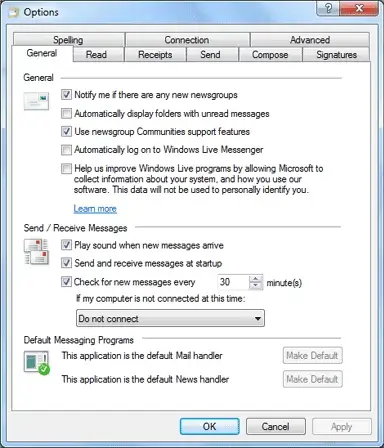
Step 2. Then, from your Options Box, go to the Advanced Tab then click on the Maintenance button.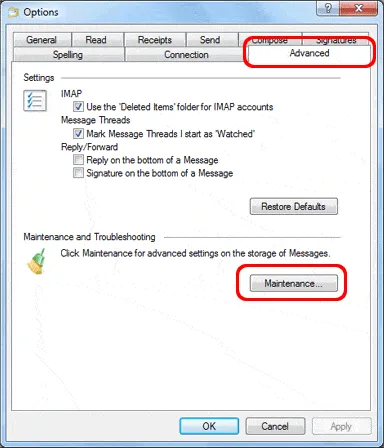
Step 3. Click on the Store Folder option.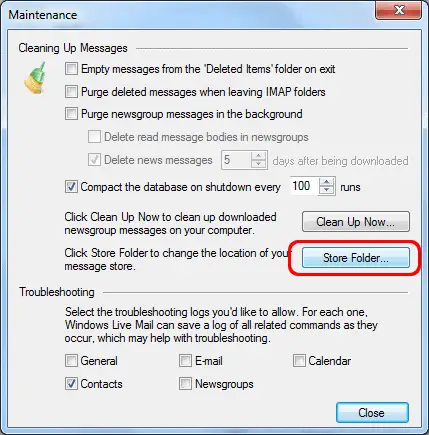
Step 4. Here is the store folder location, where you can find your email message.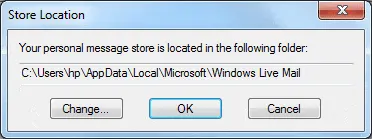
In the Windows Live Mail Store location, you can find individual folders for all users configured in Windows Live Mail.
Steps to Access EML Extension Files via Mozilla Thunderbird
Mozilla Thunderbird is a free open-source email client developed by Mozilla Firefox, which manages emails, contacts, and other mailbox data. Follow the steps below to view your EML files in Mozilla Thunderbird:
Step 1. Locate the EML files by navigating their default location in your system. Now choose any one file and right-click on it.
Step 2. Choose Open with and then click on Thunderbird.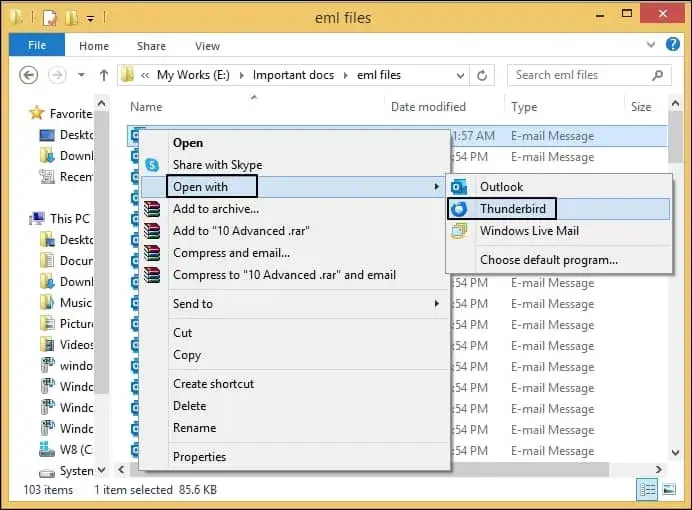
Step 3. The chosen EML file will open on your screen.
Steps to Access the EML File Extension via Outlook
Outlook is one of the most preferred email clients in professional settings in today’s world. Users can easily view their EML files in Outlook with two easy steps:
Step 1. Navigate to where your EML files are saved and right-click on any one of them.
Step 2. Select Open with from the list and click on Outlook.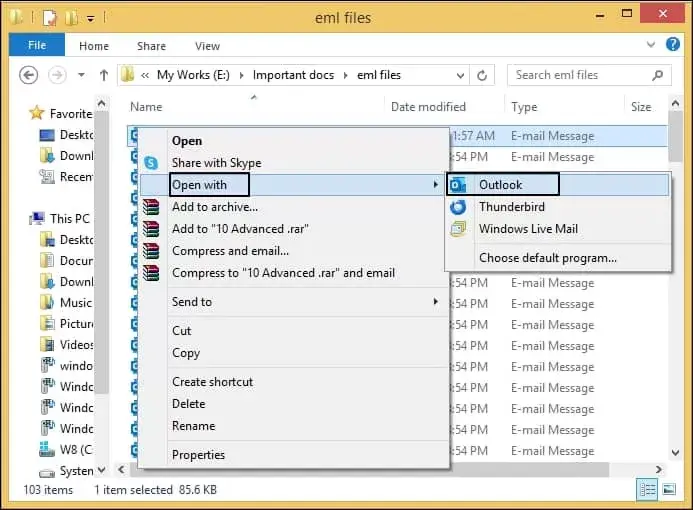
However, what if you don’t have access to any of the email clients? Using a trusted software comes in handy in this case.
How to View EML Extension Files Without an Email Client?
Email clients provide an easy and built-in way to access EML files. Although using these simple methods you can easily find and view your EML files, there are also other ways to access your EML files. Kernel EML Viewer allows you to view and access EML files with attachments and gives a detailed preview of the entire data, without needing to access any email client. that allows you to view and open EML files without Outlook or other email clients.
When Do You Need EML Viewer Tool?
- For an orphaned EML file that cannot be accessed in any email client but you need to view the data present in it.
- In case the only option you have is to view your EML online but there’s limited internet connectivity, this tool can be of help.
- If your EML file is corrupted, then there’s no chance that it can be accessed via the manual methods.
Conclusion
EML files are the simplest file format containing an entire email message and can be easily accessed on any device with any email client. With the simple methods as explained above, you can view EML files in Thunderbird, Outlook, or any other email client. Additionally, an EML viewer can be used to access EML files created using any email platform, supporting faster processing, especially when you need to open multiple files eficiently.
Frequently Asked Questions
A. Well, you can’t actually merge multiple EML files into one, but you can use the Thunderbird email client to import all .eml files and export to a single .mbox file. The other solution that allows you to merge or combine multiple EML files is using an EML Converter tool. It will allow you to export multiple EML files to a single PST, MBOX, and other file formats.
A. When emails stored in the .eml files are linked to heavy attachments, they can add up to the actual size of these files, resulting in bulky EML files.
A. To open your EML files, go to the file location > right-click on the files > select Open with > and choose Thunderbird as the email application to open the file with.