Read time: 6 minutes
Direct Answer: To delete user Exchange Online mailboxes in Office 365, admins can use the Microsoft 365 admin center or opt for Exchange Online PowerShell, as per the number of mailboxes. But different aspects need to be considered, like retention policy verification, permissions, backup, etc., before deletion of important mailbox data.
Microsoft 365 administrators manage user mailboxes daily when inactive accounts have no use, employees offboard, there are unused mailboxes, or others. Microsoft offers two native ways to delete Exchange Online mailboxes:
- Microsoft 365 Admin Center
- Exchange Online PowerShell.
This blog will showcase how to delete user Exchange Online mailboxes, what happens after deletion and the best practices to follow.
Deleted Exchange Online Mailboxes? Here’s What Happens Next
When you delete a mailbox, the outcome totally depends on how the associated Microsoft Entra ID user account is removed.
| Soft-Deleted Mailbox | Hard-Deleted Mailbox |
|---|---|
| Created when the Microsoft 365 user is deleted. | Created after permanent removal from Microsoft Entra ID or after the retention period expires. |
| Recoverable for up to 30 days. | Cannot be recovered. |
| License can usually be reassigned after deletion. | Mailbox data is permanently removed. |
| Recommended when accidental deletion is possible. | Intended for permanent mailbox removal. |
If you delete a Microsoft 365 user, Exchange Online places the mailbox in a soft-deleted state by default. During the retention period, admins can restore both the user account and mailbox if necessary.
After the retention period expires, or if the Microsoft Entra ID account is permanently removed, the mailbox becomes permanently deleted.
Prerequisite Before You Delete User Mailboxes in Exchange Online
It will take just a few minutes. Before you delete an Exchange Online mailbox, verify that the mailbox is no longer needed. Because once a mailbox is permanently removed, recovery may not be possible easily. A few more things you must take into consideration:
- Backup important emails, calendars, contacts, and attachments for extra security.
- Know if the mailbox is subject to a Litigation Hold or Microsoft Purview retention policy.
- Check that the mailbox is still under Microsoft’s default 30-day recovery period.
- After all these, remove the Microsoft 365 license to get it free for another user.
Two Native Ways to Delete User Mailboxes in Exchange Online
You can delete Exchange Online user mailboxes in two different ways, as per technical expertise and permissions. The ways are:
- Using Microsoft 365 admin center
- Using Windows PowerShell
Method 1: Delete Exchange Online Mailboxes using Microsoft 365 Admin Center
For a few mailboxes, you can use the admin center for deletion. If you delete a user account in Microsoft 365, the related mailbox from Exchange Online gets deleted. Here is how to delete user mailboxes in Microsoft 365:
- Log in to Microsoft 365 with admin credentials. Go to Users, then Active Users.
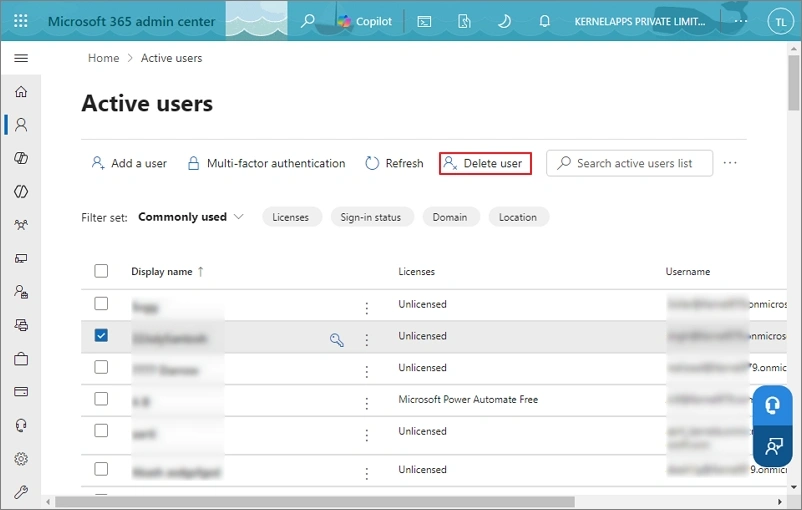
- Select the user you want to delete, then tap on Delete user.
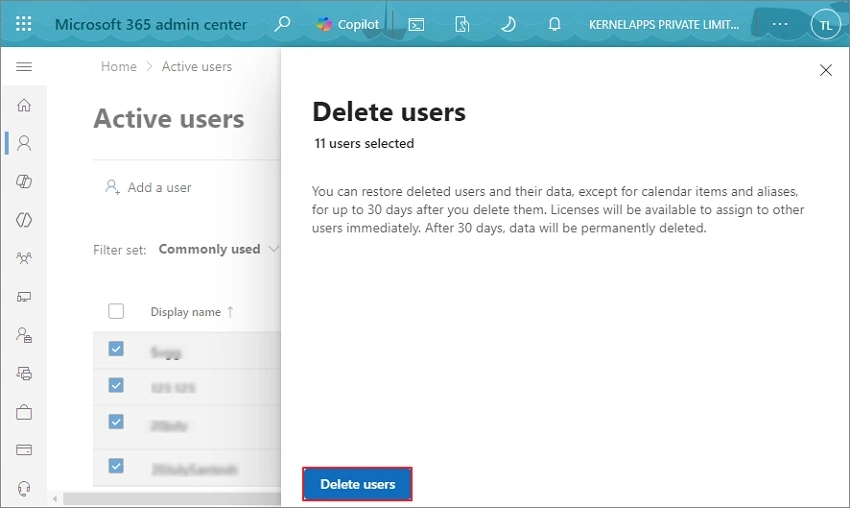
- Check out the confirmation details & tap on Delete.
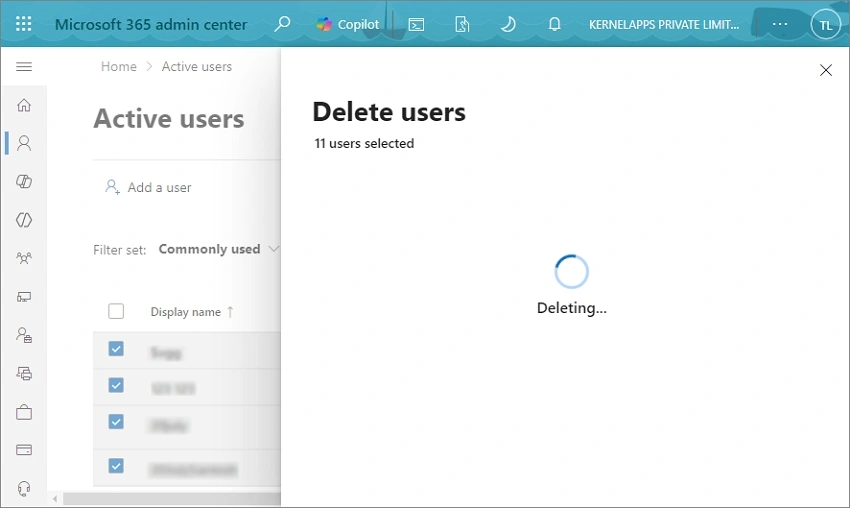
- The user mailbox deleting process will be started. Wait for a few seconds.
- The deleted user mailboxes will be listed. Review them and click Close.
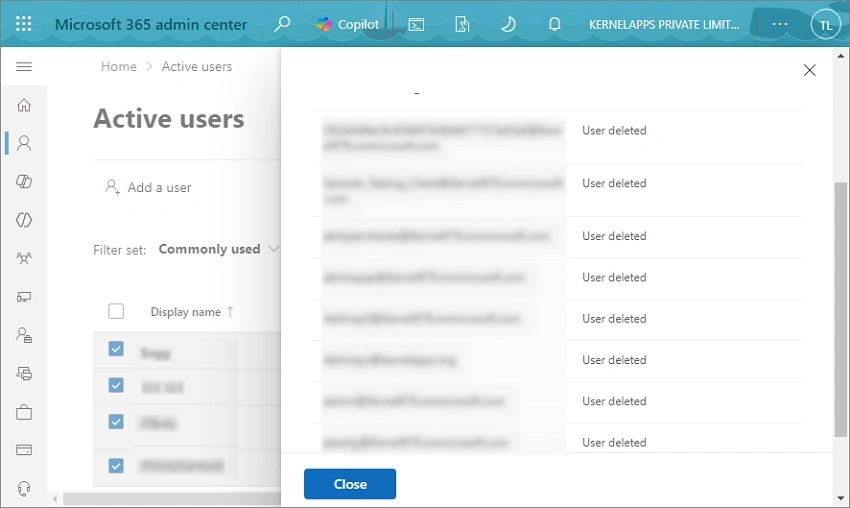
The user account in Microsoft 365 gets listed in the Deleted Users in Microsoft 365 admin center. This user mailbox can be recovered; however, you can recover it within 30 days. After 30 days, they get deleted permanently, and no options for recovery are left.
Note: After deletion, to stop paying for the license assigned to the deleted user mailbox, you need to remove its license. To do this, navigate to Billing>Subscriptions; select the subscription and then choose Add/Remove licenses.
Method 2: Delete Exchange Online Mailboxes using Windows PowerShell
Admin with PowerShell command-line skills prefer this to delete bulk user mailboxes at once. With it, you can permanently delete Exchange Online user mailboxes. The set of commands to delete user mailboxes are as follows:
- First, install the Exchange Online PowerShell Module if not installed. For that, run
Install-Module ExchangeOnlineManagement
After that, approve the installation if prompted.
- Now, connect your Microsoft 365 account to Windows PowerShell by running the command:
Connect-ExchangeOnline
Sign in using an Exchange admin account when prompted.
- To delete user mailboxes, use:
Remove-Mailbox -Identity user@domain.com
Note: Replace user@domain.com with the mailbox you want to remove and your confirmation too. You can also remove multiple ones.
- Once your task is completed, disconnect from Exchange Online. For that, run:
Disconnect-ExchangeOnline
Which Method Should You Choose? Admin Center or PowerShell
Both methods have different sets of steps and work to delete user mailboxes in Exchange Online. Understand the table below and choose what suits you:
| Microsoft 365 Admin Center | Exchange Online PowerShell |
|---|---|
| GUI-based management | Command-line flexibility |
| Easy to use | Best for PowerShell experts |
| No need for command or scripting | Supports automation |
| Ideal for deleting individual users | Ideal for bulk mailbox management |
| Recommended for most admins | Preferred by enterprise IT teams |
Challenges You Might Face When Deleting Exchange Online Mailboxes
Admins may encounter a lot of challenges where the mailbox cannot be removed immediately.
- Admin-level permissions are insufficient.
- Shared or resource mailboxes exist.
- Hybrid Exchange deployments in organizations.
- A mailbox is under Litigation Hold, eDiscovery Hold, or a Microsoft Purview retention policy.
- Microsoft Entra Connect is syncing identities from an on-premises Active Directory.
Is it Possible to Recover a Deleted Exchange Online Mailbox?
Yes. It is possible to recover a deleted Exchange Online mailbox (when the associated mailbox is in a soft-deleted state). Thus, you can recover it within 30 days.
Once the retention period is over or if the account is permanently removed, the mailbox becomes unrecoverable, and you might then need another backup or retention solution.
Why Back Up Exchange Online Mailboxes Before Deletion?
After the retention period ends, there is no way to undo the deletion or recover your mailboxes manually. But with an effective backup solution, you can restore mailbox data [emails, attachments, calendars, contacts, etc.].
Even native backup methods like eDiscovery and PST Export exist, but for large-scale backup, they often lag behind. If your firm needs long-term mailbox backup and recovery, Kernel Office 365 Backup and Restore tool can help. It provides an additional layer of protection against accidental or permanent data loss. Get your free trial version and get the experience of the tool.
Conclusion
We hope you are well-through with soft delete and hard delete, after-effects, checklist and methods to delete user mailboxes. As discussed above, for a few Exchange mailbox deletions, the Exchange admin center is a wise choice, but for large-scale tasks, Exchange PowerShell can be a viable option. But one provocative thing to consider is data protection for future needs. Use the recommended professional backup solution to easily back up Exchange Online mailboxes before you delete them.
Frequently Asked Questions
A: Yes, deleting a Microsoft 365 user also deletes the associated Exchange Online mailbox.
A: Yes, you can remove an Exchange Online mailbox without deleting the Microsoft 365 user account, but the process depends on your environment and requirements.
A: Yes. You must. Also, it helps free Microsoft 365 licenses for another user.
A: Yes, but with Exchange Online PowerShell only. Here, admins can automate or perform bulk mailbox deletion.