

User Question: Can I migrate Google Chat to Microsoft Teams manually?
Answer: Yes, you can manually move Google chat data to Microsoft Teams by using the copy paste approach but it only works for a small volume of data. For larger volumes of data, it is wise to use an efficient migration tool to transfer Google chat content accurately.
Microsoft Teams provides ease of collaboration by providing centralized communication in Microsoft 365. While both Google Chat and Teams provide threaded messaging and file sharing, organizations often migrate Google Chats to Teams. The Google Chat to Teams migration provides advanced security, more control, and effortless workflow in the Office 365 environment.
But, till today in 2026, there is no official native manual method [except the time-consuming copy-paste approach] to help you move the message and attachments between these two platforms.
Why Organizations Perform Google Chat to Teams Migration?
Google Chat to Microsoft Teams migration helps organizations unify their communication tools under Microsoft 365 environment. Moreover, Google Chat’s retention capability is handled via Google Vault while Microsoft Teams uses Microsoft Purview, eDiscovery, and retention policies. Export Google Chats to centralize all communication under Microsoft 365 governance. Here are some prominent reasons why businesses perform this migration:
- Integrates smoothly with Microsoft Entra ID (formerly Azure AD).
- Enhanced scalability for large Channels and Teams.
- Comprehensive Graph API and automation support.
- Advanced channel architecture (Standard, Private, and Shared).
- Restricts guest capabilities with centralized Entra ID external collaboration setting.
- Enforces compliance rules within the same corporate tenant automatically.
- Files shared in chats get automatically stored in the SharePoint document library.
Migrate Google Chat to Microsoft Teams: Fast & Secure Way
As we know, you can copy paste the Google chat content but there is no streamlined native method for Google Chat to Teams migration, so using a dedicated software is the only option. The Kernel Google Workspace to Office 365 migration tool is developed for precise Chat’s threads migration with all its objects, such as:
- Direct messages, Groups Chats & Spaces, (1:1 chats).
- Messages, respective threads, replies.
- Attachments, files, images, video, emojis, GIFs.
- Metadata, hyperlinks, mentions, meeting links, etc.
Steps to Migrate Google Chat to Teams Using the Tool
Note: We will continue the process with the Google Spaces option.
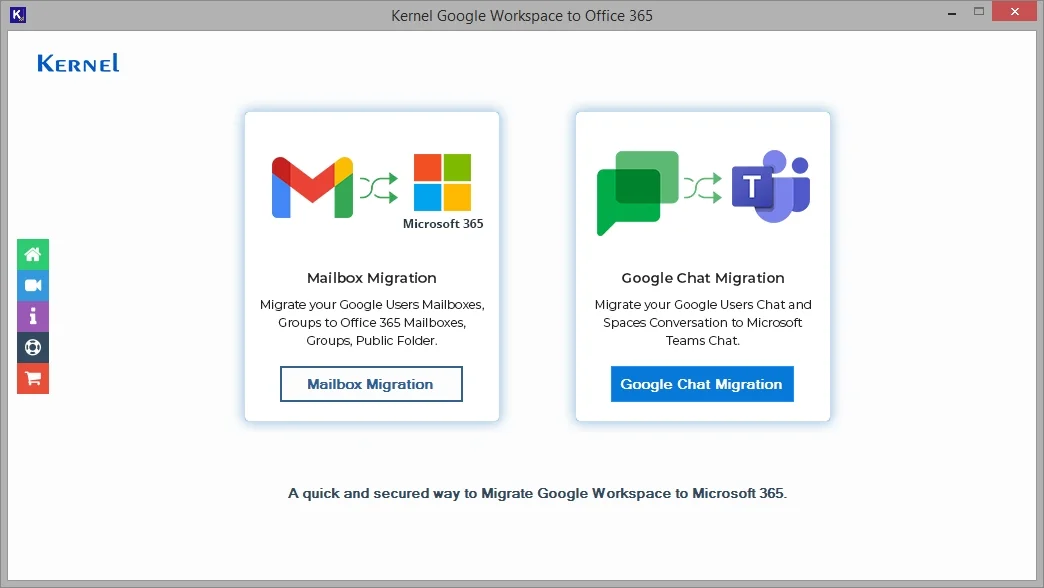
- Download and launch the tool, then select Google Chat Migration to migrate your Google users’ chat to Microsoft Teams.
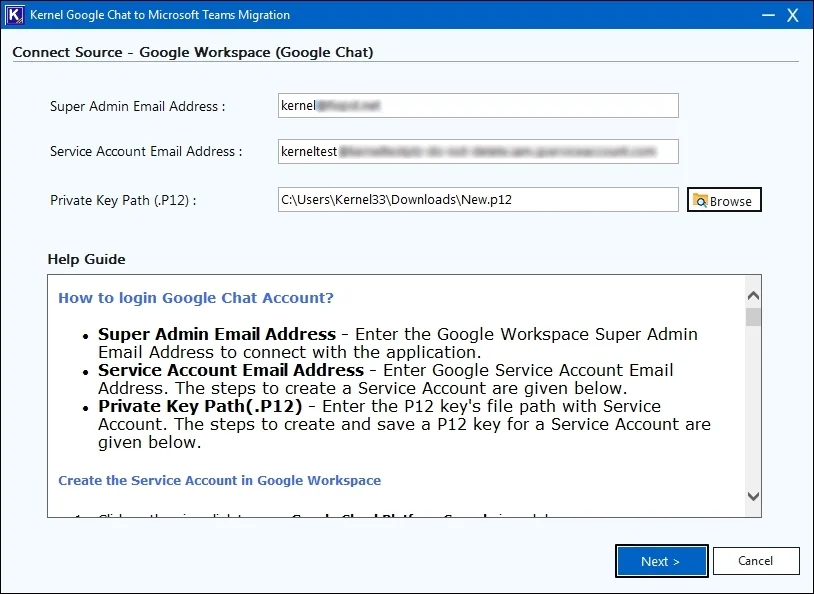
- Enter Google Workspace (Google Chat) credentials, including Super Admin Email ID, Service Account Email Address, and select Private Key path (.P12). Click Next to proceed with the migration process.
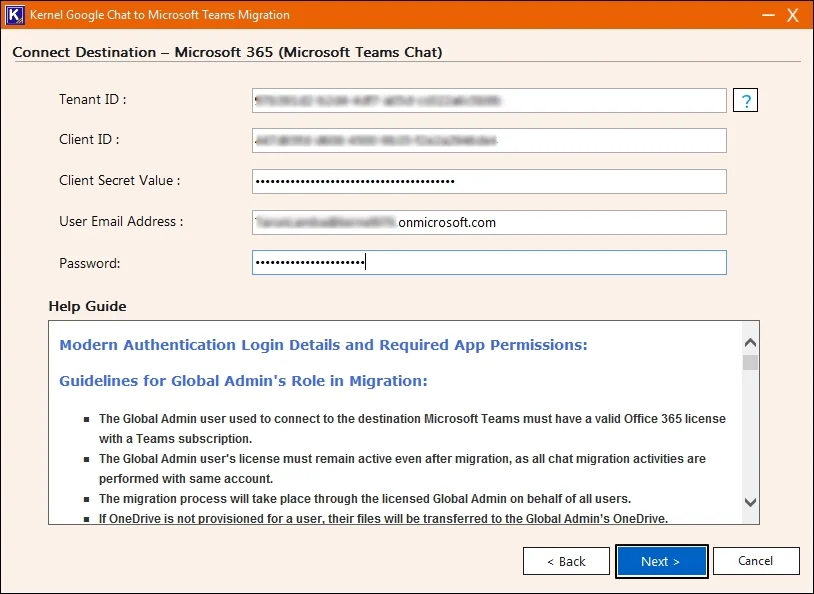
- Enter details like Tenant ID, Client ID, Client Secret Value, User Email Address, and the Password to connect the tool with the target Microsoft Teams Chat. Click Next to connect.
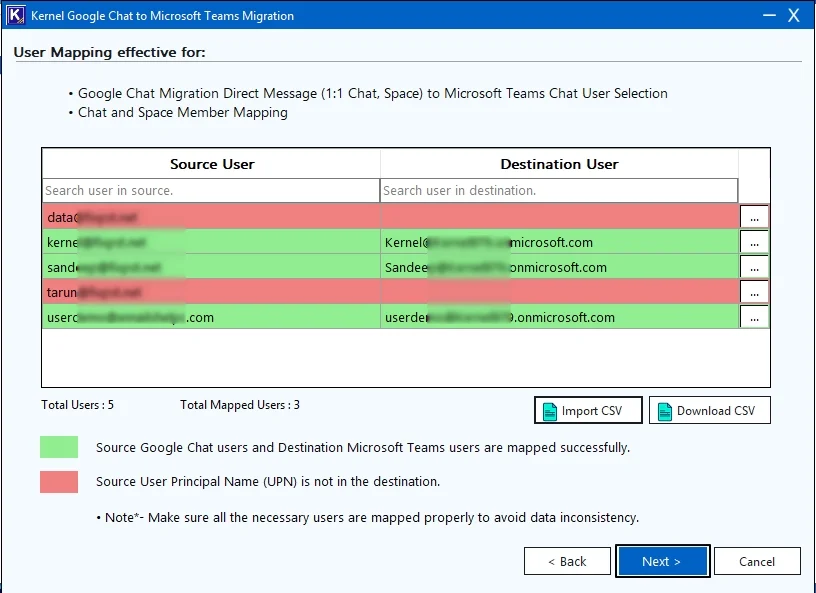
- Once the Source and Destination are connected, you’ll be redirected to User mapping. If a Source Google Chat user is also available at the destination, the tool will automatically map the source user with the destination user.
Note: Unmapped users will be highlighted in red. To map them manually, click on the three dots button corresponding to each user and map them.
- In the Select Google Chat Entities To Migrate wizard, you can either select Direct Messages or select Google Spaces.
Note: We will continue the process with the Google Spaces option.
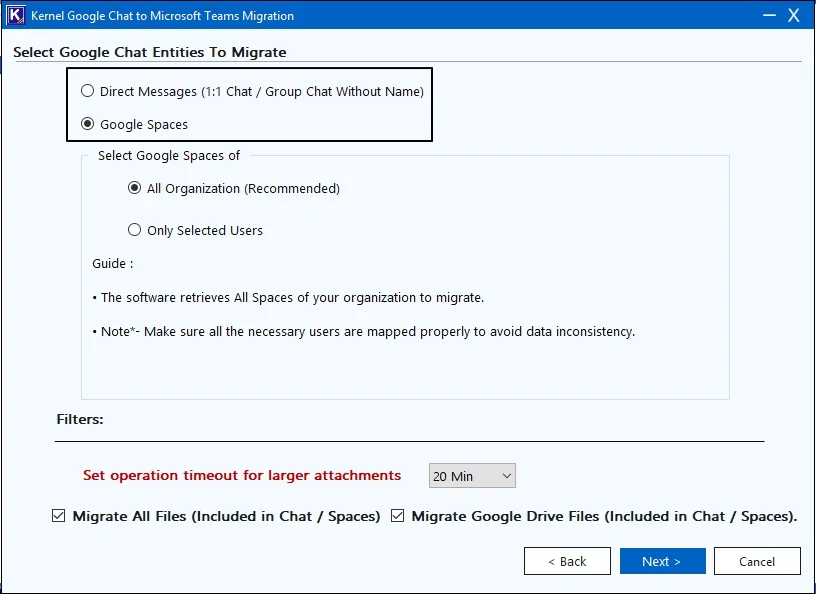
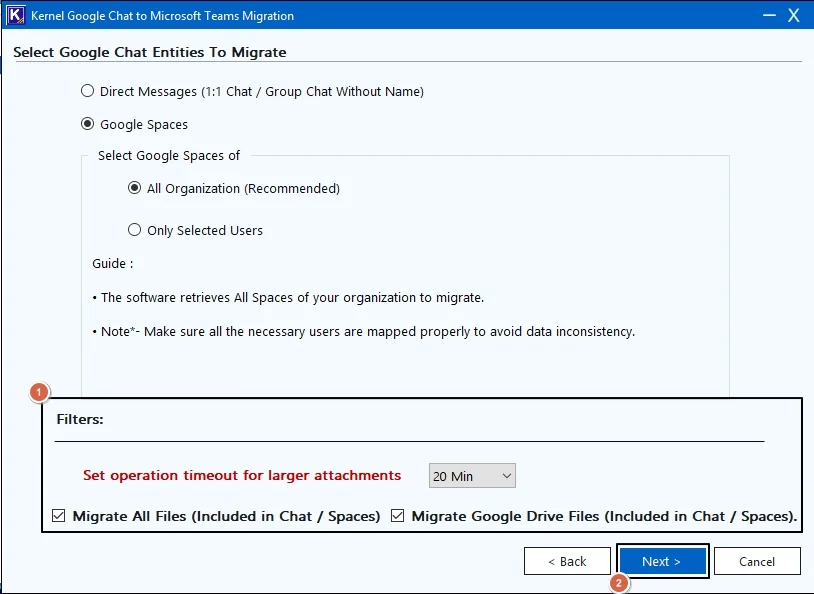
- Next, in the Filters section, apply specific different filters from:
- Set operation timeout for larger attachments: Define a time limit. If migrating an attachment file takes longer than the selected time, the file will be skipped.
- Migrate files (Included in Chat / Spaces): To migrate files, such as JPGs, PDFs, DOCs, and many more, along with chat or spaces.
- Migrate Shared Drive Files (Included in Chat / Spaces): Migrate Shared Drive files of the Google Chat and Spaces into Microsoft Teams.
- After applying all the filters, click Next.
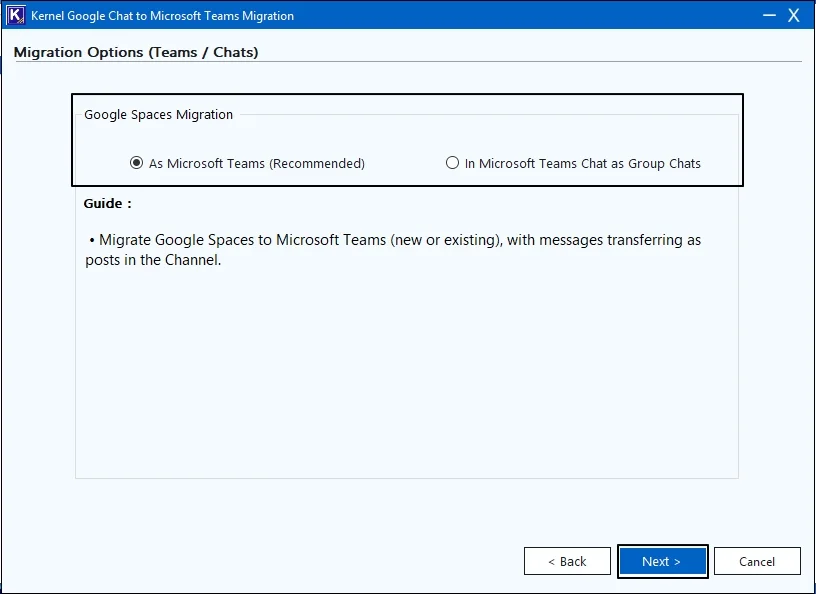
- In the Migration Options (Teams / Chats) window, select any of the options from: As Microsoft Teams (Recommended) option and In Microsoft Teams Chat as Group Chats, then click Next.
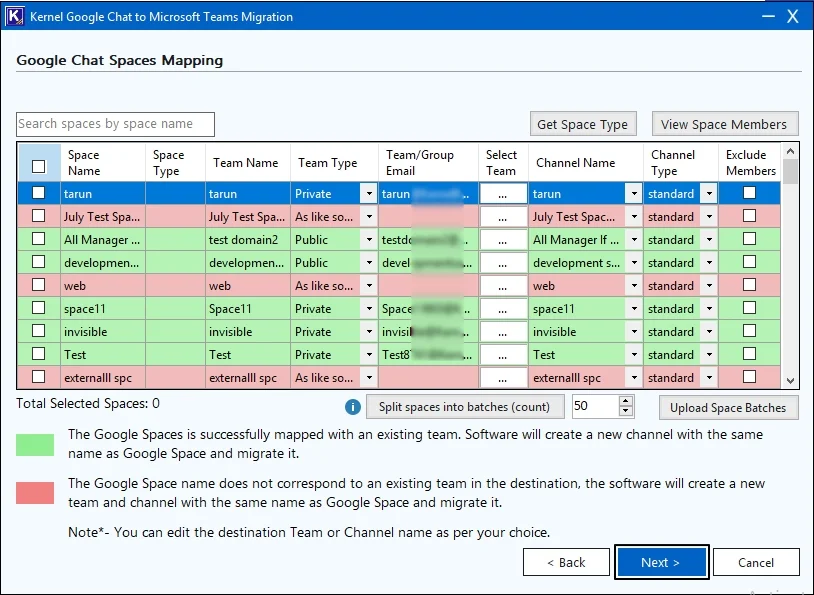
- In the Google Chat Space Mapping window, map spaces to Teams accordingly and click Next to begin Google Chat to Teams migration.
- The software will start and show the live migration process.
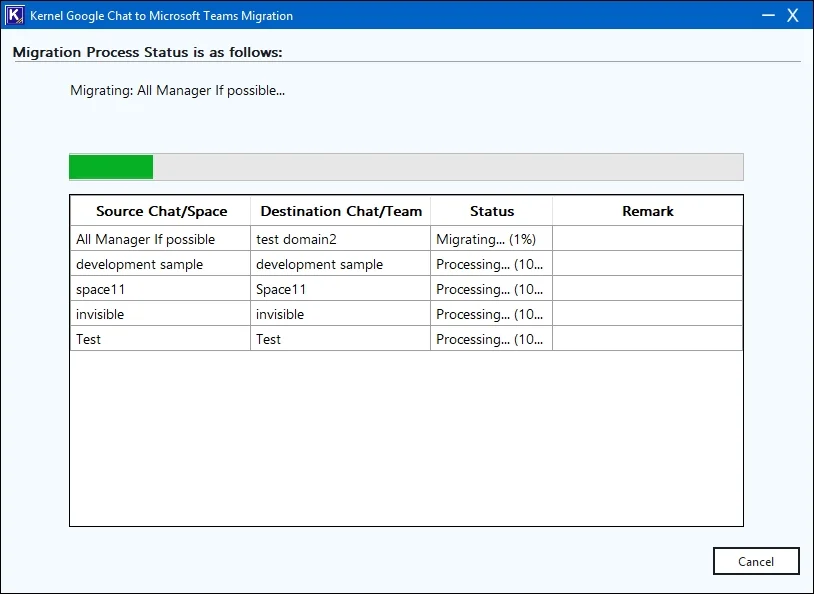
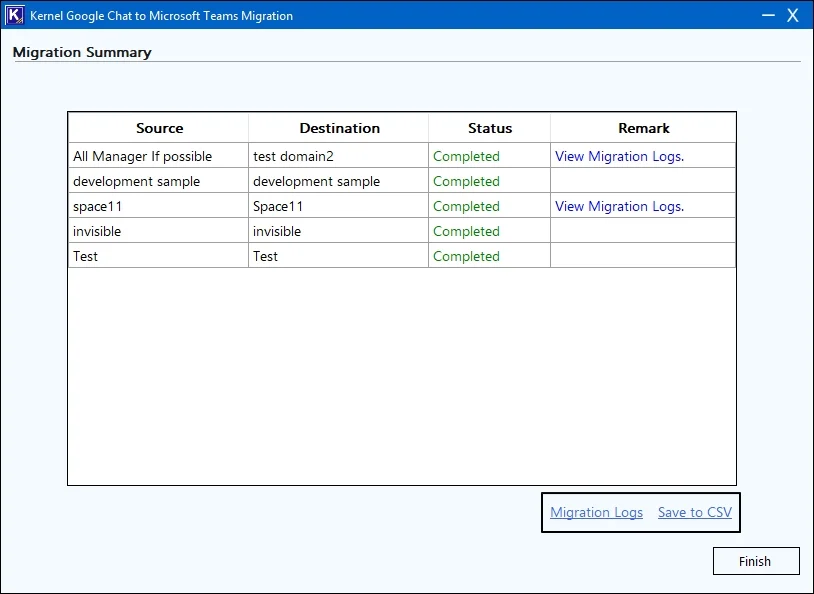
- When migration is completed, a success message will pop up. Click OK to close the pop-up.
- To view the migration summary, click on Migration Logs. And to download the summary, click on the Save to CSV option. Click Finish to exit the tool.
Google Chat to Teams Migration | Best Practices and Tips
To speed up the Google Chat to Teams migration, go through these practices followed by admins:
- Find and remove obsolete data, and delete old 1:1 chats that you don’t need.
- Move large files to a separate folder and migrate them later. Oversize items can delay or stop migration.
- Make sure the source GWS account has the required Domain-Wide permissions and scope to allow Chat & Space migration.
- Create source GWS user’s account in destination Office 365 for easy mapping and Chat to Teams message transfer.
- Migrate Google Chat to Teams during off-peak hours or holidays. This will minimize migration time.
- Ask the employees or users to avoid sending messages during the migration to avoid any data sync issues.
- Perform a test migration with 2 or 3 user Chats before initiating a large-scale move.
Post-Migration Steps and User Training
To prevent issues after migration, perform these tasks:
- Verify if all the messages and their replies are correctly displayed in the original hierarchy with the correct sender and receiver names.
- Open random attachment files to check if they are accessible and load without losing any information or quality.
- Click on the hyperlinks to see if they are still pointing to the correct destination on the web.
- It's crucial that you train your employees for the new Office 365 environment to minimize human errors.
- You cannot check everything at once. Create a portal where your users can inform you about any unexpected errors or missing data.
Google Chat vs Microsoft Teams | Quick Comparison
Get an overview of how the messaging platforms of Google and Microsoft differ.
| Feature | Google Chat | Microsoft Teams |
|---|---|---|
| Best For | Startups and agile organizations that want browser-based apps. | Massive enterprises and Windows-centric organizations. |
| Add-ins & Extensions | Has Google Workspace Marketplace with a focus on lightweight apps. | Offers several enterprise ecosystem apps through Microsoft AppSource. |
| Security Features | You get Google Vault (eDiscovery/retention), simplified admin center, and more | Offers enterprise-grade security with Microsoft Purview, Granular DLP, Entra ID, compliance tracking, etc. |
| Pricing | Starter: $7/user/mo Standard: $14/user/mo Plus: $22/user/mo Enterprise: Custom | Teams Essentials: $4/user/mo Bus. Basic: $7/user/mo Bus. Standard (with Copilot): $23.5/user/mo Bus. Premium: $22/user/mo Enterprise (E3/E5): 39–60/user/mo |
| System Impact | Low: Browser-first architecture with negligible RAM/CPU drain, except during video rendering. | High: Heavy memory consumption and CPU load, particularly during screen sharing & rendering streams |
Author’s Verdict on Google Chat to Teams Migration
Considering the increasing popularity of Microsoft, organizations are moving towards Office 365, and Microsoft Teams is a part of the suite. With an advanced Kernel Google Workspace to Office 365 migration tool, you can easily migrate Google Chat to Teams with original time stamps, message hierarchy, and attachments. The tool not only moves your Chats and Spaces but also migrates user mailboxes and groups from GWS to Microsoft 365.
Frequently Asked Questions
What are the common challenges in Google Chat to Teams migration?
- Thread context loss like date stamp, sender name, etc.
- Maintaining original quality and formatting of attachments.
- Source & destination user mapping.
- Replicating the permission of source in destination.
- Handling chats of inactive users.
Does the tool make sure to keep my original in the original order?
Yes, our tool uses advanced algorithms to map each message to the right user and display them in the original chronological order.
What will happen to my emojis, message reactions, and mentions?
They will all be moved as it is with the respective message when you migrate Google Chat to Teams.
Can I use Google Chat during the migration?
You can. But I advised not to do it, because there is a possibility that new messages might fail to migrate from Google Chat to Teams.
Will our "Private" Google Spaces stay private in Teams?
Yes. Our professional tool maps permissions and access scope accurately. Every private conversation will remain private & restricted in the destination Teams also.
Can I use Google Chat in Microsoft Teams?
Yes, you can use Google Chat in Microsoft Teams but not natively on your own, you will need to use a specialized software.